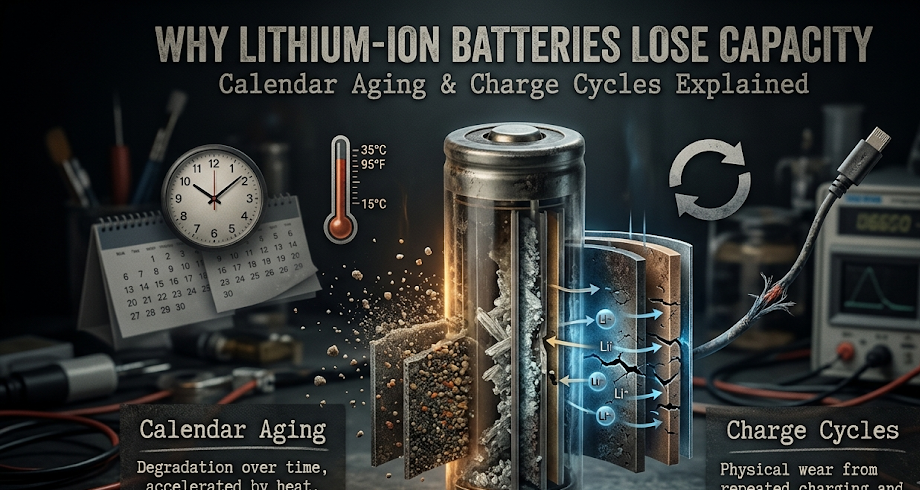
A new smartphone can last an entire day on one charge. A few years later, the same phone may need charging before dinner.
Laptops, wireless earbuds, electric vehicles, and rechargeable tools can experience similar changes.
The battery still works, but it no longer stores as much usable energy as it once did.
This happens because lithium-ion batteries gradually change chemically and physically as they age.
Some of those changes occur while the battery is being used.
Others happen simply because time passes.
Scientists generally describe these two major categories as calendar aging and cycle aging.
Understanding the difference helps explain why an unused battery can deteriorate, why repeated charging matters, and why temperature is so important.
How a Lithium-Ion Battery Stores Energy
A lithium-ion battery stores energy through reversible electrochemical reactions.
Inside a typical cell are two electrodes, an electrolyte, and a separator.
The negative electrode is commonly graphite-based, although other materials may also be used.
The positive electrode contains a lithium-bearing material, such as a layered metal oxide or lithium iron phosphate.
During charging, lithium ions move through the electrolyte toward the negative electrode.
Electrons travel through the external electrical circuit as energy is supplied.
During discharge, the process reverses.
Lithium ions move toward the positive electrode, while electrons travel through the external circuit and power the connected device.
The battery’s ability to repeat these processes depends on maintaining stable electrode materials and chemical interfaces.
Over time, unwanted reactions and structural changes reduce the amount of energy the cell can deliver.
LITHIUM-ION CELL / BASIC COMPONENTS
Stores lithium during charging in many common cell designs.
Allows lithium ions to move between electrodes.
Participates in reversible lithium storage and release.
What Does Battery Capacity Mean?
Battery capacity describes how much electrical charge a battery can deliver under specified conditions.
It is commonly measured in ampere-hours or milliampere-hours.
For energy storage, watt-hours are also important because they account for voltage.
A new battery has a rated capacity determined through standardized testing.
As the battery ages, its usable capacity gradually declines.
For example, a battery that originally delivered 5,000 milliampere-hours might eventually deliver only 4,000 milliampere-hours under comparable test conditions.
That would represent approximately 80% of its original capacity.
However, real-world battery runtime also depends on device power consumption, temperature, and operating conditions.
Capacity is not the only characteristic that changes with age.
Internal resistance may also increase, making it harder for the battery to supply high power efficiently.
Calendar Aging: Why Batteries Deteriorate Over Time
Calendar aging refers to degradation that occurs as time passes, even when a battery is not undergoing repeated charge and discharge cycles.
A battery stored in a drawer is not chemically inactive.
Slow reactions can continue inside the cell.
These reactions may consume usable lithium, change electrode surfaces, or alter electrolyte components.
As a result, the battery can gradually lose capacity without being used regularly.
The Solid Electrolyte Interphase
One important feature of many lithium-ion batteries is the solid electrolyte interphase, commonly called the SEI.
This thin layer forms on the negative electrode during early battery operation.
A stable SEI is essential because it helps protect the electrode from continuous electrolyte decomposition while allowing lithium ions to pass.
However, the layer can continue changing as the battery ages.
Additional growth may consume lithium that would otherwise participate in normal charging and discharging.
This contributes to capacity loss.
Other chemical processes can also contribute to calendar aging, depending on cell chemistry and storage conditions.
Why Storage Temperature Matters
Higher temperatures generally accelerate many chemical reactions.
That includes unwanted reactions inside lithium-ion batteries.
A battery stored in a hot vehicle or exposed to prolonged high temperatures may degrade faster than one stored under moderate conditions.
Temperature is therefore one of the most important influences on calendar aging.
Why State of Charge Matters
The battery’s state of charge can also influence aging.
For many lithium-ion chemistries, spending long periods at very high states of charge increases degradation rates.
High cell voltage can accelerate certain side reactions.
However, the relationship varies with chemistry and battery management design.
This is one reason many manufacturers recommend partial charge levels for long-term storage.
AGING MECHANISM / 01
Calendar Aging = Time + Chemical Reactions
Even without regular use, lithium-ion cells can lose capacity because internal chemical processes continue during storage.
Cycle Aging: What Happens During Charging and Discharging?
Cycle aging describes degradation associated with repeated battery use.
Each time a lithium-ion battery charges and discharges, lithium ions move between electrode materials.
These movements cause small changes in the electrodes.
Over many cycles, some materials may develop mechanical stress, surface changes, or unwanted chemical reactions.
Electrodes can gradually lose some of their ability to store lithium reversibly.
Cycle aging can also increase internal resistance.
The amount of degradation depends on how the battery is used.
Important factors include temperature, charging rate, discharge rate, depth of discharge, and cell chemistry.
What Counts as One Charge Cycle?
A charge cycle is not necessarily one occasion when you plug in your phone.
Manufacturers commonly describe a full equivalent cycle as cumulative use equal to 100% of the battery’s capacity.
For example, using 40% of the battery’s capacity and later using another 60% adds up to approximately one equivalent full cycle.
These partial discharges may occur across multiple charging sessions.
The exact cycle-counting method depends on the battery management system and manufacturer.
Therefore, charging your phone twice in one day does not automatically mean you have used two complete cycles.
CHARGE CYCLE LAB / SIMPLE EXAMPLE
Partial Battery Use Adds Together
40% + 60% = Approximately One Equivalent Full Cycle
This is a simplified illustration. Actual battery aging depends on more than cycle count alone.
Calendar Aging vs. Cycle Aging
Both aging processes occur throughout a battery’s life.
They are not completely independent because temperature, state of charge, and usage conditions influence both.
A frequently used battery may experience substantial cycle-related degradation.
A rarely used battery may still lose capacity through calendar aging.
In real devices, both processes usually contribute to overall battery health.
| Feature | Calendar Aging | Cycle Aging |
|---|---|---|
| Main influence | Time and storage conditions | Charging and discharging |
| Occurs during storage? | Yes | Not without cycling |
| Temperature effect | High heat often accelerates aging | Temperature influences degradation during use |
| Charge level effect | Long periods at high charge may increase aging | Charge range and cycle depth influence wear |
| Typical result | Capacity loss and resistance changes | Capacity loss and resistance changes |
Why Heat Is One of the Biggest Battery Enemies
Heat can accelerate chemical reactions inside a lithium-ion battery.
Some of these reactions are necessary for normal operation.
Others contribute to unwanted degradation.
Prolonged exposure to high temperatures can increase capacity loss and internal resistance.
Charging while the battery is unusually hot may create additional stress.
For example, a phone left in direct sunlight while running demanding applications and charging may experience elevated battery temperatures.
Modern devices often include thermal controls that reduce charging speed or limit performance when temperatures rise.
These protections help manage risk, but they do not make extreme heat harmless.
Following the manufacturer’s operating temperature guidance is an important part of battery care.
Does Fast Charging Damage Lithium-Ion Batteries?
Fast charging increases the rate at which energy enters a battery.
Higher charging rates can generate more heat and increase electrochemical stress under some conditions.
At low temperatures or high charging rates, certain cells may also face a greater risk of lithium plating.
Lithium plating occurs when metallic lithium deposits on the negative electrode instead of being stored through the intended process.
This can contribute to capacity loss and, under some conditions, safety concerns.
However, modern battery systems are designed with charging limits, temperature monitoring, and control algorithms.
Many devices reduce charging current as the battery approaches full charge.
Therefore, fast charging does not automatically cause rapid damage.
The effect depends on battery chemistry, temperature, charging power, and the quality of the management system.
Using approved chargers and avoiding excessive heat are sensible precautions.
Why Charging to 100% Can Increase Aging
For many lithium-ion cells, higher states of charge correspond to higher cell voltages.
Spending extended periods at elevated voltage can accelerate certain unwanted chemical reactions.
This is one reason some smartphones, laptops, and electric vehicles offer optimized charging or charge-limit settings.
These features may delay charging to 100% or allow users to select a lower maximum charge level.
However, charging to 100% is not inherently unsafe when the device operates as designed.
Battery management systems define appropriate operating limits.
The concern is mainly about long-term degradation from repeated or prolonged high-voltage exposure.
If full capacity is needed for travel or a long workday, using the battery’s available range is reasonable.
Battery care should support practical use rather than make the device inconvenient.
Why Deep Discharges Can Also Matter
Depth of discharge describes how much of a battery’s available capacity is used during a cycle.
A shallow cycle uses a relatively small portion of the available capacity.
A deep cycle uses a much larger portion.
For many lithium-ion systems, repeated deep cycling can produce more degradation per cycle than shallower cycling under comparable conditions.
However, the relationship depends on chemistry, voltage limits, temperature, and how cycle life is measured.
Modern devices include protective controls that prevent cells from reaching damaging voltage extremes during normal operation.
Allowing a phone to display 0% does not necessarily mean the cell has reached a truly empty electrochemical state.
Even so, repeatedly leaving devices fully discharged for extended periods is generally undesirable.
What Does Battery Health Percentage Actually Mean?
Many smartphones and laptops display an estimated battery health percentage.
This commonly represents the battery’s estimated maximum capacity relative to its original capacity.
For example, an 85% battery health reading suggests that the battery can currently store approximately 85% of its original capacity under the manufacturer’s estimation method.
However, battery health readings are estimates rather than perfect measurements.
They depend on software models, battery management data, and operating conditions.
Different manufacturers may calculate or display battery health differently.
A battery with reduced capacity may also experience increased resistance, which can affect performance under heavy loads.
Battery replacement decisions should consider actual runtime, device behavior, safety, and manufacturer guidance rather than a single percentage alone.
Why Battery Chemistry Makes a Difference
Not all lithium-ion batteries use the same electrode materials.
Common positive-electrode chemistries include lithium nickel manganese cobalt oxide, lithium cobalt oxide, and lithium iron phosphate.
These chemistries have different characteristics involving energy density, cost, thermal behavior, and cycle life.
For example, lithium iron phosphate batteries are often valued for their cycle-life characteristics and thermal stability.
Other chemistries may offer higher energy density, which is valuable in compact devices.
However, battery lifespan cannot be predicted from chemistry alone.
Cell design, manufacturing quality, temperature, voltage limits, and battery management are also important.
Two batteries using the same broad chemistry may age differently under different operating conditions.
Practical Ways to Extend Lithium-Ion Battery Life
Battery aging cannot be stopped completely.
However, several practical habits can reduce unnecessary stress.
BATTERY CARE LAB / EVERYDAY HABITS
Keep devices away from prolonged direct sunlight, hot vehicles, and other high-temperature environments.
Enable optimized charging or charge limits when they suit your daily routine.
Recharge when convenient instead of deliberately draining the battery completely.
For long-term storage, follow the manufacturer’s guidance on charge level and temperature.
Choose manufacturer-approved or appropriately certified chargers and cables.
Common Battery Myths Explained
Myth: You Must Drain a Lithium-Ion Battery Completely Before Charging
Modern lithium-ion batteries do not require routine full discharges to prevent the memory effect associated with some older rechargeable battery technologies.
Partial charging is generally acceptable.
Myth: Every Charging Session Uses One Full Cycle
Cycle counts generally reflect cumulative battery usage rather than the number of times a charger is connected.
Myth: An Unused Battery Never Ages
Calendar aging continues during storage, particularly under unfavorable temperature and charge conditions.
Myth: Battery Health Can Be Restored Through a Software Trick
Software calibration may improve the accuracy of some charge estimates, but it cannot reverse the underlying chemical degradation of an aged battery.
When Should a Battery Be Replaced?
Battery replacement may be appropriate when reduced capacity significantly affects everyday use.
Signs can include much shorter runtime, unexpected shutdowns, or performance limitations associated with battery condition.
Manufacturers may provide service recommendations based on estimated battery health and device diagnostics.
Safety is especially important.
A battery that becomes swollen, unusually hot, damaged, or otherwise abnormal should not be ignored.
Stop using or charging a device with signs of battery damage and follow the manufacturer’s safety instructions.
Battery replacement should be performed according to the product’s service guidance, particularly for devices with sealed or difficult-to-access batteries.
Frequently Asked Questions
Why do lithium-ion batteries lose capacity?
They gradually degrade because of chemical and physical changes associated with time, temperature, charging, and discharging.
What is calendar aging?
Calendar aging is battery degradation that occurs over time, including while the battery is stored or used infrequently.
What is cycle aging?
Cycle aging is degradation associated with repeated charging and discharging.
Does charging to 100% damage a battery?
Charging to 100% within the device’s designed limits is normal, but prolonged time at high charge levels can accelerate aging in many lithium-ion chemistries.
Is fast charging bad for battery health?
Fast charging can increase stress under some conditions, especially when temperatures are high. Modern battery management systems help control charging rates and temperatures.
Does an unused lithium-ion battery lose capacity?
Yes. Chemical aging can continue during storage, even without regular charge cycles.
Can battery health return to 100%?
Normal chemical aging is not reversed by charging habits or software. A replacement battery may restore the device’s original battery capacity.
Final Thoughts
Lithium-ion batteries are remarkably useful because they store substantial energy in compact, rechargeable systems.
However, they are not permanent energy-storage devices.
Calendar aging gradually changes a battery’s chemistry as time passes.
Cycle aging adds wear through repeated charging and discharging.
Temperature, state of charge, charging rate, and battery chemistry all influence the pace of degradation.
These processes can reduce usable capacity and increase internal resistance.
Although no charging habit can completely prevent aging, sensible temperature management and manufacturer-supported charging features can help reduce unnecessary stress.
The most useful lesson is that battery health depends on both time and use.
A battery can age while sitting unused, and it can age faster when repeatedly exposed to demanding conditions.
Understanding these processes makes it easier to care for smartphones, laptops, electric vehicles, and other rechargeable devices without relying on misleading battery myths.