The Solid Electrolyte Interphase (SEI) is widely recognized as the single most critical, complex, and decisive nanoscale phenomenon in modern battery electrochemistry. First coined by electrochemist Emanuel Peled in 1979, the SEI is a passivating passivation layer that spontaneously forms on the negative graphite or silicon anode during the initial charge formation cycle of a lithium-ion battery. Functioning as a selective ionic gate that allows monovalent lithium ions ($Li^+$) to pass freely while completely blocking destructive electron tunneling, understanding SEI formation thermodynamics, organic/inorganic bilayer architecture, dynamic degradation modes, and artificial stabilization chemistries is fundamental to mastering battery cycle life and safety.
The Core Paradox of the SEI Layer
The graphite anode of a lithium-ion battery operates at 0.05V vs. Li/Li⁺—far outside the thermodynamic electrochemical stability window of organic carbonate electrolytes (< 0.8V). Theoretically, the electrolyte should continuously decompose until all solvent is consumed. The SEI resolves this paradox: it forms an electrically insulating, ionically conductive passivating barrier that arrests further continuous electrolyte reduction, enabling the battery to cycle reversibly for thousands of cycles.
1. Formation Thermodynamics: The LUMO/HOMO Electrochemical Window
To understand why the SEI forms, one must examine the electronic energy levels of the battery components according to frontier molecular orbital theory:
Every non-aqueous liquid electrolyte possesses an intrinsic electrochemical stability window defined by the energy gap ($E_g$) between its Lowest Unoccupied Molecular Orbital (LUMO) and Highest Occupied Molecular Orbital (HOMO):
- The Anode Reduction Boundary (LUMO): Standard alkyl carbonate solvents (Ethylene Carbonate, Dimethyl Carbonate) have a LUMO level corresponding to an electrochemical reduction potential of approximately 0.80V to 1.00V vs. Li/Li⁺.
- The Negative Electrode Fermi Level ($\mu_A$): As a graphite anode intercalates lithium during the very first charge, its chemical potential rises, driving its electrochemical potential down toward 0.05V vs. Li/Li⁺. Because the Fermi energy of the lithiated graphite ($\mu_A$) sits far above the LUMO of the electrolyte, electrons spontaneously tunnel from the graphite electrode into the electrolyte molecules, triggering aggressive reductive decomposition.
If the decomposition products were soluble, this reduction would continue indefinitely until the electrolyte was completely dried out and the cell died. Fortunately, in the presence of appropriate salts ($LiPF_6$) and cyclic carbonates ($EC$), the decomposition products precipitate out as an insoluble, solid nano-film on the anode surface—the Solid Electrolyte Interphase.
2. Nanoscale Bilayer Morphology: The Peled Mosaic Model
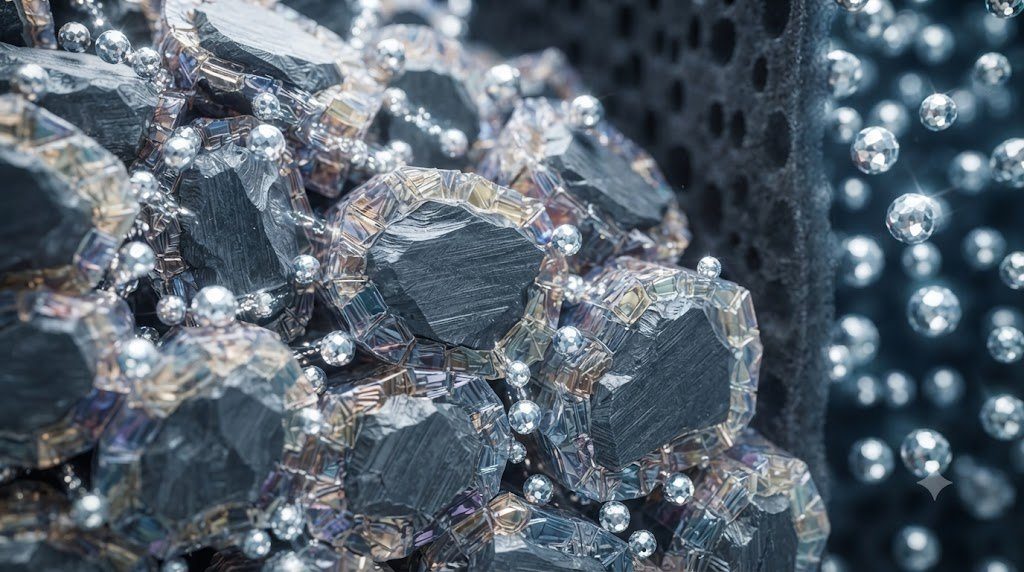
Advanced cryo-transmission electron microscopy (Cryo-TEM) and X-ray photoelectron spectroscopy (XPS) have revealed that the SEI is not a homogenous film, but an intricate mosaic bilayer measuring between 10 and 50 nanometers in thickness:
The Dense Inorganic Inner Layer (Directly Contacting the Anode)
Directly adjacent to the graphite or silicon surface lies a compact, dense layer composed primarily of inorganic lithium salts formed from the reduction of the electrolyte salt ($LiPF_6$):
- Lithium Fluoride ($LiF$): Formed from salt hydrolysis and fluorinated additives. $LiF$ is an exceptional electronic insulator with high mechanical shear modulus and wide bandgap, preventing electron tunneling while providing structural stiffness.
- Lithium Carbonate ($Li_2CO_3$) and Lithium Oxide ($Li_2O$): Provide compact crystalline matrices that anchor the film to the carbon lattice.
The Porous Organic Outer Layer (Facing the Bulk Liquid Electrolyte)
Facing the liquid electrolyte solution is a softer, flexible, partially porous layer consisting of organic and polymeric reduction species formed from the two-electron reduction of ethylene carbonate ($EC$):
- Lithium Ethylene Dicarbonate (LEDC / $(CH_2OCO_2Li)_2$): The dominant organic building block. LEDC forms flexible oligomeric chains that absorb mechanical breathing as graphite expands by ~10% during lithium intercalation.
- Alkyl Carbonates and Polycarbonates: Impart elasticity to prevent film detachment under thermal expansion.
3. First-Cycle Irreversible Capacity Loss (ICL) and Industrial Formation Protocols
Because the creation of the SEI consumes both active lithium ions and solvent molecules permanently, every lithium-ion cell suffers from First-Cycle Irreversible Capacity Loss (ICL):
In standard graphite anodes, between 5% and 12% of total cell lithium capacity is permanently trapped in the SEI layer during initial charging. In high-capacity silicon-dominant anodes, ICL can exceed 20% to 30% due to silicon’s massive active surface area.
The Industrial Formation and Aging Process
In battery gigafactories, newly assembled and electrolyte-filled cells undergo a rigorous, multi-week formation and aging protocol:
- Slow-Rate Precision Charging: Cells are charged at very low currents (e.g., $C/20$ to $C/10$) under strictly controlled temperatures (typically 35°C to 45°C). Charging slowly allows reduction products to nucleate and self-assemble into a smooth, dense, pinhole-free film rather than chaotic, porous dendrite-inducing aggregates.
- High-Temperature Aging and Degassing: Cells are placed in environmental chambers for 7 to 14 days. Parasitic gassing (ethylene, hydrogen) generated during SEI formation is vacuumed out through specialized degassing pouches before final hermetic seal crimping.
| SEI Characteristic | Ideal Passivating SEI Layer | Degraded / Unstable SEI Layer |
|---|---|---|
| Electronic Conductivity | Strictly Zero (< 10⁻¹² S/cm; blocks electrons) | Leaky (Electrons tunnel through, decomposing electrolyte) |
| Ionic Conductivity (Li⁺) | High (> 10⁻⁶ S/cm; unhindered ion hopping) | Sluggish (High impedance, massive voltage drop under load) |
| Mechanical Properties | Elastic, ductile, high adherence (accommodates strain) | Brittle, fragile (Cracks and spalls during lithiation breathing) |
| Thickness | Stable, self-limiting (10 to 25 nanometers) | Continuously growing (100+ nm; chokes electrolyte channels) |
| Chemical Solubility | Completely insoluble in organic carbonates | Partially soluble (Dissolves into liquid at elevated temperatures) |
| Thermal Stability | Resistant up to 120°C+ | Exothermically decomposes prematurely at 70°C – 80°C |
4. Dynamic Degradation: Cracking, Continuous Growth, and Lithium Inventory Loss
The SEI is not a static museum piece; it is a dynamic, living interface that undergoes continuous wear, fracturing, and parasitic reconstruction throughout the operating life of the battery:
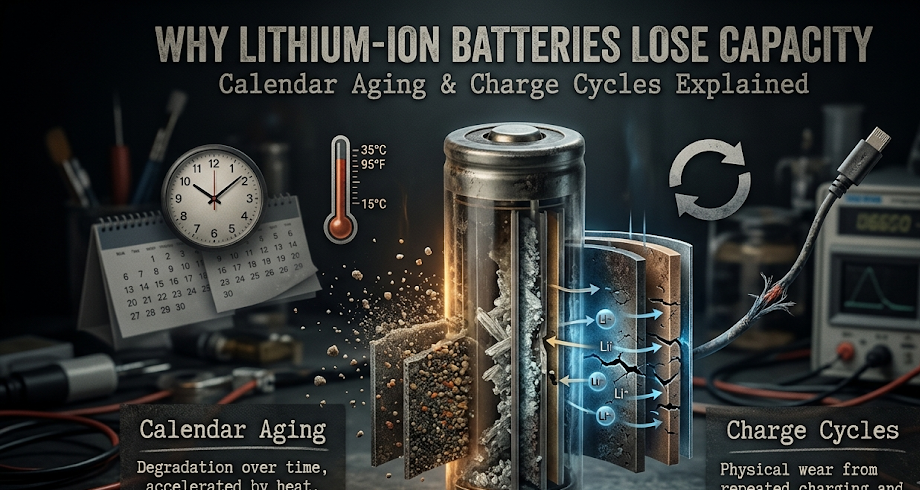
- Loss of Lithium Inventory (LLI): As a battery cycles over years, mechanical expansion causes microscopic fissures to crack the brittle SEI film. Fresh liquid electrolyte immediately penetrates the crack, contacting bare lithiated graphite. New SEI instantly forms to heal the rupture, consuming more active lithium ions and solvent. This continuous, slow consumption of cyclable lithium is the primary driver of gradual capacity fade in all commercial lithium batteries.
- Transition Metal Dissolution and Poisoning: At the positive cathode, trace hydrofluoric acid ($HF$) leaches manganese and nickel ions ($Mn^{2+}, Ni^{2+}$) out of ternary cathodes. These dissolved transition metal cations migrate across the separator and embed themselves into the negative SEI layer. Once embedded, manganese ions act as electrocatalysts that drastically accelerate electron transfer across the SEI, triggering runaway electrolyte decomposition and catastrophic cell impedance rise!
5. Electrolyte Additive Engineering: VC, FEC, and Film Modifiers
To chemically engineer a superior, robust SEI layer, chemical formulators blend specialized sacrificial film-forming functional additives into the electrolyte at concentrations between 0.5% and 5% by weight:
- Vinylene Carbonate (VC): Possessing an unsaturated carbon-carbon double bond ($C=C$), VC reduces electrochemically at ~1.4V vs. Li/Li⁺—well before ethylene carbonate decomposes. VC undergoes radical polymerization to form poly(vinylene carbonate) crosslinked polymer networks that make the SEI remarkably flexible, elastic, and impervious to cracking.
- Fluoroethylene Carbonate (FEC): Essential for silicon-containing anodes. FEC decomposes to produce uniform, densely packed nanocrystalline Lithium Fluoride ($LiF$) domains throughout the SEI matrix. The high mechanical toughness of $LiF$ effectively accommodates the brutal 300% volume swings of alloyed silicon particles.
- Prop-1-ene-1,3-sultone (PST) and Lithium Difluorophosphate ($LiPO_2F_2$): Form sulfur- and phosphorus-rich protective surface coatings that suppress transition metal deposition and improve high-temperature calendar life.
6. The Cathode Counterpart: The Cathode Electrolyte Interphase (CEI)
While the negative anode undergoes reductive decomposition, high-voltage positive cathodes (operating at potentials > 4.2V vs. Li/Li⁺) suffer oxidative decomposition of the electrolyte at their Highest Occupied Molecular Orbital (HOMO) boundary. This forms a protective counterpart on the positive electrode known as the Cathode Electrolyte Interphase (CEI):
A stable CEI consists of polymeric carbonates, polyethers, and dense $LiF/Li_xPO_yF_z$ salt fragments that passivate catalytic transition metal sites, suppressing phase transitions from layered to rock-salt structure and preventing toxic oxygen gas release during high-voltage fast charging.
7. Artificial SEI Engineering: Ex-Situ Polymer and Inorganics
To bypass the chaotic, non-uniform nature of naturally formed SEI films and eliminate first-cycle irreversible capacity loss, materials scientists are developing pre-fabricated artificial SEI coatings applied directly to anodes before cell assembly:
- Molecular Layer Deposition (MLD) of Alucone Films: Depositing organic-inorganic hybrid alucone thin films via gas-phase MLD creates highly compliant, elastic surface barriers that stretch dynamically as graphite or silicon expands, preventing direct electrolyte contact while maintaining rapid ion hopping channels.
- Chemical Pre-Lithiation Strategies: Dusting anode slurries with stabilized lithium metal powder (SLMP) or treating electrodes with organolithium chemical solutions pre-fills the lithium consumption inventory before cell sealing. This elevates first-cycle Coulombic efficiency from 85% to over 96% to 98%, unlocking 10% higher pack-level usable energy density.
- Self-Healing Supramolecular Binders: Incorporating hydrogen-bonding polymers (such as polyacrylic acid modified with ureido-pyrimidinone quadrupolar motifs) enables ruptured micro-cracks in the artificial interphase to autonomously self-heal within hours at ambient temperatures.
8. Advanced In-Situ Characterization: Cryo-TEM, Operando NMR, and AFM
Deciphering the atomic structure and chemical dynamics of the SEI was historically hindered by the extreme sensitivity of the film: exposing an extracted anode to air or high-energy electron beams immediately destroys the organic lithium carbonates. Revolutionizing our understanding required breakthroughs in cryogenic and operando analytical instruments:
Cryogenic Transmission Electron Microscopy (Cryo-TEM): Pioneered for batteries by Stanford researchers, flash-freezing battery electrodes in liquid nitrogen preserves the SEI in its pristine, frozen-hydrated native state. High-resolution Cryo-TEM allows direct atomic lattice imaging of $LiF$ nanocrystals embedded within amorphous organic matrices with zero electron beam damage.
Operando Solid-State Nuclear Magnetic Resonance (ssNMR): NMR spectroscopy non-destructively tracks the local chemical coordination and diffusion pathways of lithium isotopes ($^7Li$) in real time as the battery charges, differentiating between lithium trapped in dead SEI salts and cyclable lithium ions intercalating into the host lattice.
9. Calendar Aging Models: The Square-Root of Time Law
Even when an electric vehicle or stationary storage battery sits completely idle in a parking garage without delivering any electrical current, it undergoes unavoidable capacity degradation known as calendar aging, driven entirely by continuous sub-nanometer SEI growth:
Because electron tunneling across the passivating inorganic SEI layer is diffusion-limited, classical electrochemical kinetics dictates that the thickness of the film (delta) and cumulative lost lithium capacity ($Q_{loss}$) grow proportional to the square root of storage time ($\sqrt{t}$):
Where the rate constant $k$ is an exponential function of temperature governed by Arrhenius kinetics and elevated state of charge. Storing a battery at 100% SoC in a scorching 45°C summer environment accelerates this diffusion constant by over 400%, multiplying calendar aging rate and causing premature pack retirement decades before mechanical cycle limits are approached.
10. Frequently Asked Questions Regarding the Solid Electrolyte Interphase (SEI)
What is the Solid Electrolyte Interphase (SEI)?
The SEI is a protective nanometer-thick passivation layer that forms on the battery’s negative anode during the first charge, blocking electron flow while allowing lithium ions to pass.
Why is the SEI layer necessary for a lithium-ion battery to work?
Without an SEI, the liquid organic electrolyte would continuously react with the low-potential anode and decompose, completely destroying the battery in just a few cycles.
What is First-Cycle Irreversible Capacity Loss (ICL)?
It is the 5% to 15% of total battery capacity that is permanently consumed during the first charge cycle to create the chemical compounds that make up the SEI layer.
What are the two primary layers of the SEI mosaic model?
A dense, thin inorganic inner layer (LiF, Li2CO3, Li2O) on the anode surface, and a softer, flexible organic outer layer (LEDC, polycarbonates) facing the liquid electrolyte.
What causes the SEI to break down during battery aging?
Repeated charging and discharging causes graphite to expand and contract, cracking the brittle SEI. Fresh electrolyte reacts with exposed carbon to heal cracks, continuously eating active lithium.
What is Vinylene Carbonate (VC) and what does it do?
VC is an electrolyte additive that decomposes first during formation to create a tough, flexible polymeric layer that protects the anode from cracking and degradation.
Why is Fluoroethylene Carbonate (FEC) essential for silicon anodes?
FEC decomposes to form an abundance of Lithium Fluoride (LiF) in the SEI, providing the high mechanical stiffness needed to survive silicon’s 300% volume changes.
How does transition metal dissolution harm the SEI?
Manganese and nickel ions dissolved from the cathode cross over to the anode, embedding in the SEI and acting as catalysts that accelerate parasitic electrolyte decomposition.
What is the Cathode Electrolyte Interphase (CEI)?
The CEI is the equivalent protective passivation film that forms on the positive cathode to prevent high-voltage oxidative breakdown of the electrolyte.
At what temperature does the SEI decompose in thermal runaway?
The SEI begins breaking down exothermically between 80°C and 120°C, exposing lithiated graphite to direct electrolyte combustion and initiating thermal runaway.