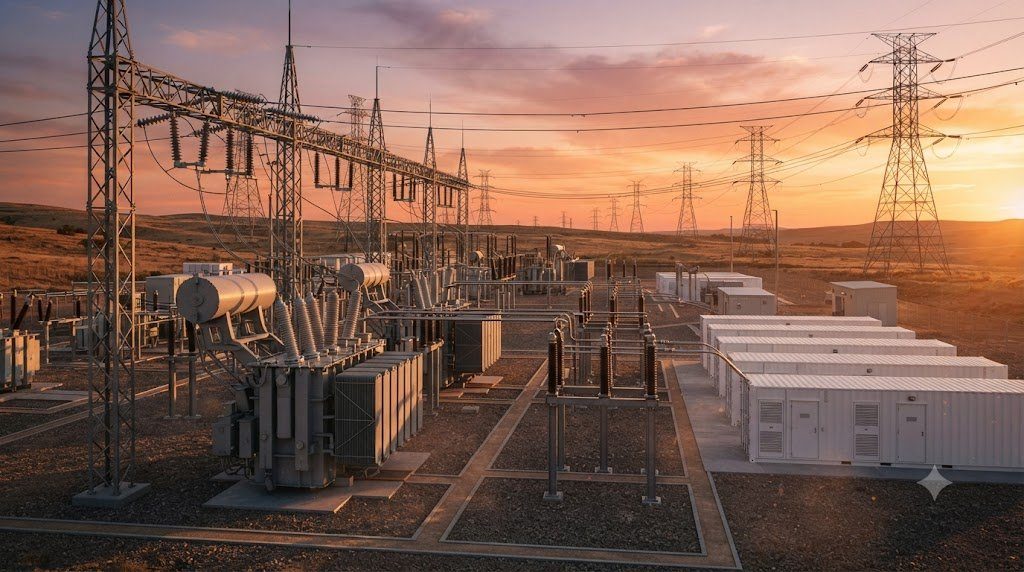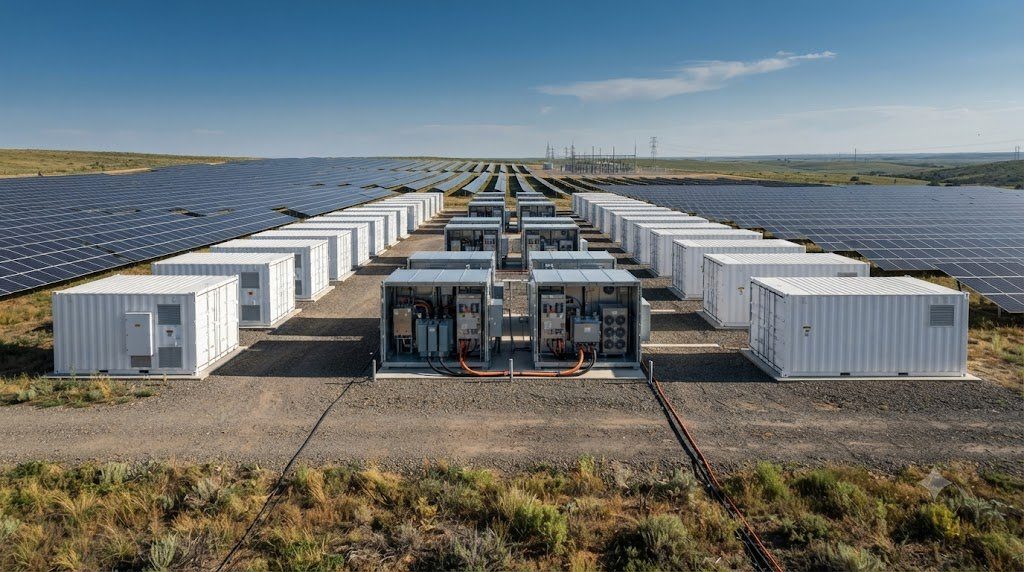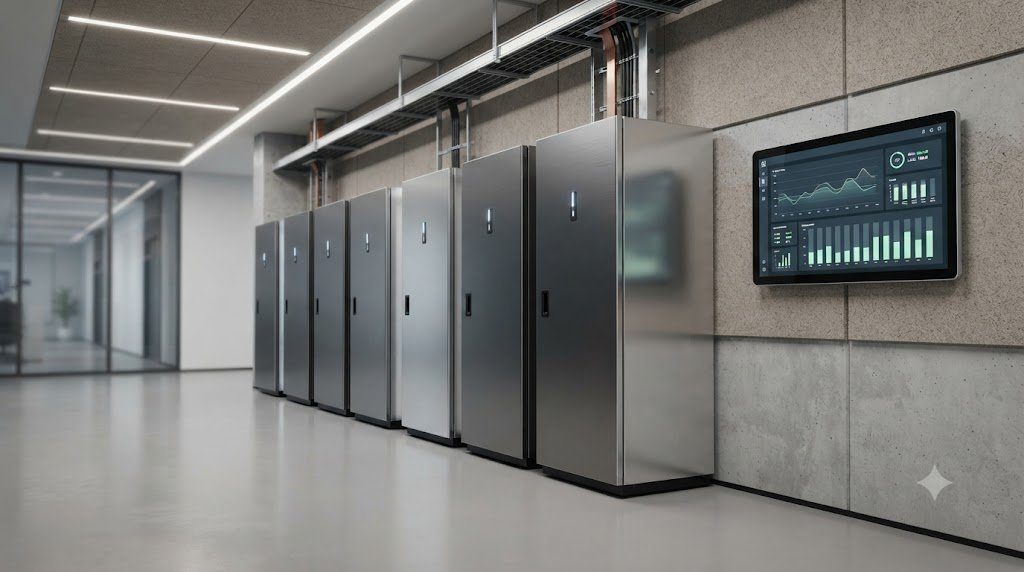
While utility-scale energy storage operates in front of the utility meter on high-voltage transmission networks, Behind-the-Meter (BTM) Commercial & Industrial (C&I) Energy Storage operates on the customer side of the electric utility meter. Installed at manufacturing plants, corporate campuses, data centers, cold-storage warehouses, and hospitals, BTM systems transform corporate energy economics. By executing intelligent peak shaving, demand charge management, time-of-use (TOU) arbitrage, solar self-consumption optimization, and backup power resilience, BTM systems convert volatile utility electric bills into predictable financial assets.
The Financial Reality of Industrial Electric Bills
In many commercial and industrial utility rate tariffs, up to 30% to 70% of a company’s monthly electric bill is determined not by total kilowatt-hours consumed, but by ‘Demand Charges’—a severe financial penalty assessed on the single highest 15-minute power demand spike recorded during the entire billing month.
1. The Mechanics of Demand Charges: The 15-Minute Peak Trap
To understand why commercial enterprises invest heavily in stationary batteries, one must dissect commercial utility billing tariffs:
Electric utilities must build and maintain generation and transmission capacity sized to survive peak instantaneous demand spikes. To recover these infrastructure costs, utilities assess Demand Charges ($/kW/month). The utility meter continuously averages power draw over rolling 15-minute billing intervals:
- If a factory operates steadily at 200 kW for 29 days, but on one afternoon fires up massive heavy chillers, injection molding machines, or arc welding equipment that spikes power draw to 1,000 kW for merely 20 minutes, the utility bills demand charges on the full 1,000 kW peak for the entire month!
- At demand charge rates ranging from $15 to $40 per kilowatt in regions like California, New York, and Massachusetts, that single brief 20-minute spike can add $15,000 to $40,000 in penalties to that month’s electric bill.
2. Peak Shaving Economics: Mathematical Clamping of Demand Thresholds
The premier economic application of BTM battery storage is automated peak shaving:
A dedicated power meter at the main electrical service entrance continuously streams real-time building power consumption to the on-site battery controller. Facility managers establish an engineered Peak Demand Threshold (e.g., 500 kW):
Whenever internal machinery demand threatens to exceed 500 kW, the BESS discharges instantaneously (within milliseconds), supplying the excess power locally. To the utility meter outside, power draw never exceeds 500 kW. The battery completely absorbs the spike, shaving off the peak and saving tens of thousands of dollars each billing cycle.
| Industrial Application | Facility Load Profile | Primary BTM Battery Role | Typical Battery Sizing | Economic Payback Period |
|---|---|---|---|---|
| Data Centers | Continuous flat load with extreme backup need | Uninterruptible Power Supply (UPS) + peak shaving | 500 kW – 5 MW / 2 – 4 hr | 4 – 6 years (Replaces dirty diesel testing) |
| Cold Storage Warehouses | High cycling compressor loads, extreme spikes | Peak shaving + aggressive TOU energy shift | 250 kW – 1 MW / 2 – 4 hr | 3 – 5 years (High demand charge savings) |
| EV Fleet Depots | Astronomical evening spikes from 20+ chargers | Buffer charging demand, prevent grid upgrade | 500 kW – 2 MW / 2 – 4 hr | 3 – 4 years (Avoids $500k transformer upgrade) |
| Hospitals & Healthcare | Mission-critical continuous life safety | Resilience backup power + demand reduction | 1 MW – 3 MW / 4 hr | 5 – 7 years (Combined resilience + tariff savings) |
| Manufacturing Plants | Heavy inductive motor startup loads | Power factor correction + voltage sag support | 500 kW – 2.5 MW / 2 hr | 3 – 5 years (Reduces motor trip downtime) |
3. Time-of-Use (TOU) Energy Arbitrage and Solar Co-Location
Beyond demand charges, commercial tariffs feature drastic Time-of-Use (TOU) volumetric rate differentials:
- Electricity during off-peak night hours or mid-day solar surplus hours may cost only $0.08 per kWh. During summer on-peak windows (typically 4:00 PM to 9:00 PM), the exact same electricity spikes to $0.35 to $0.50 per kWh!
- Commercial Solar Self-Consumption: In states with diminished Net Energy Metering (such as California’s NEM 3.0), exporting surplus rooftop solar power back to the grid yields trivial wholesale credits (2 to 4 cents/kWh). By charging an on-site BTM battery with surplus solar during noon hours and discharging that energy on-site during 5:00 PM peak rates, the facility captures the full retail spread of over 30 cents per kilowatt-hour.
4. EV Fleet Depot Electrification: Buffering Multi-Megawatt Charging Demands
The rapid transition of commercial delivery vans, city transit buses, and semi-trucks to electric power is colliding with physical utility grid constraints:
When 30 electric delivery vans return to a distribution depot at 6:00 PM and plug into 50 kW DC chargers simultaneously, the localized depot power draw surges instantaneously by 1.5 megawatts. In most municipal commercial districts, the local distribution feeder and utility transformer are physically incapable of supplying 1.5 MW without extensive, multi-year utility substation upgrades costing hundreds of thousands of dollars.
Installing a 500 kW / 2 MWh BTM battery system solves this grid bottleneck immediately: the battery charges slowly at a manageable 100 kW trickle rate throughout the idle daytime hours, and then discharges rapidly at 1.5 MW into the fleet chargers in the evening, acting as an electrical shock absorber that eliminates utility interconnection delays.
5. Emergency Resilience and Microgrid Islanding Topologies
For critical infrastructure facilities—including hospitals, semiconductor fabs, and municipal water purification plants—power outages cause catastrophic financial and physical damage:
- Automatic Transfer Switches (ATS) and Microgrid Controllers: When grid voltage drops below threshold, an ultra-fast static transfer switch (STS) physically disconnects the facility from the utility grid within 16 milliseconds (less than one AC cycle), preventing computer server reboots and automated production line crashes.
- Grid-Forming Inverters: The BTM battery inverter shifts from grid-following mode to grid-forming mode, establishing a stable 60 Hz / 480V AC voltage waveform locally. On-site rooftop solar arrays continue producing power inside the isolated microgrid island, creating an indefinitely self-sustaining resilient energy hub even during multi-day grid blackouts caused by severe storms.
6. Sizing Methodologies: 1-Hour vs. 2-Hour vs. 4-Hour System Duration
Selecting the optimal power rating (kW) and energy capacity (kWh) for a commercial BTM project requires granular interval meter data analysis:
Energy engineers ingest 12 to 24 months of 15-minute Green Button interval meter data from the utility to simulate load duration curves. If a facility exhibits tall, narrow demand spikes lasting only 30 to 45 minutes, a 1-hour to 2-hour duration battery (e.g., 250 kW / 500 kWh) delivers maximum demand charge ROI at lowest capital cost. If the facility is subject to wide 5-hour peak TOU billing windows or requires extended emergency backup, a 4-hour duration system (e.g., 250 kW / 1,000 kWh) is economically justified.
7. Software Architecture: Machine Learning for Predictive Load Forecasting
A BTM battery cannot simply discharge blindly; if it exhausts its charge at 2:00 PM on a moderate load bump, it will be completely empty when a massive, bill-ruining demand peak hits at 4:30 PM!
Advanced C&I Energy Management Software deploys neural network predictive load forecasting models. By analyzing historical facility consumption trends, calendar schedules, ambient temperature and humidity forecasts (which dictate HVAC compressor loads), and solar irradiance forecasts, the controller accurately predicts the exact magnitude and timing of that day’s peak spike. The software holds battery charge in reserve and executes surgical, precision peak shaving exactly when needed to ensure zero monthly demand threshold exceedance.
8. Power Factor Correction and Harmonic Mitigation
In industrial manufacturing plants dominated by large electric motors, pumps, and arc furnaces, inductive electrical loads cause the AC current waveform to lag behind voltage, degrading facility Power Factor (PF < 0.90):
Utilities penalize poor power factor with steep monthly surcharges. Modern BTM Power Conversion Systems feature four-quadrant bidirectional inverters that can independently inject leading or lagging reactive power (kVAR) into the facility distribution bus without discharging actual kilowatt-hours from the battery cells. The PCS acts as a dynamic STATCOM (Static Synchronous Compensator), correcting power factor to unity (PF = 0.99) and active filtering harmonic distortions caused by variable frequency drives (VFDs).
9. Project Financing: Energy-Storage-as-a-Service (ESaaS) Models
A typical commercial 500 kW / 1 MWh BTM installation requires a capital outlay between $400,000 and $700,000, creating budgeting barriers for many businesses:
To accelerate commercial deployment, financial developers offer Energy Storage as a Service (ESaaS) contracts:
- Zero Upfront Capital (CapEx = $0): The third-party developer designs, finances, permits, installs, operates, and maintains the battery system at zero upfront cost to the host enterprise.
- Shared Savings Agreements: The host enterprise and the storage developer split the verified utility bill savings (typically a 70/30 or 60/40 split) over a 10-year contract term. The host business enjoys instantaneous reduction in monthly operating overhead with zero technology or maintenance risk.
10. Permitting, Zoning, and Fire Code Compliance (NFPA 855)
Installing multi-hundred-kilowatt-hour lithium battery enclosures adjacent to occupied commercial buildings requires strict municipal permitting compliance:
Authorities Having Jurisdiction (AHJ) enforce NFPA 855 (Standard for the Installation of Stationary Energy Storage Systems). Compliance mandates maximum allowable energy thresholds per unit (typically 50 kWh indoors for non-listed systems, or 600 kWh outdoor modular units), minimum 3-foot to 10-foot physical separation clearances from building exterior walls and lot lines, continuous combustible gas detection, mechanical exhaust ventilation, and complete full-scale fire test reports proving zero thermal runaway propagation according to UL 9540A testing.
11. Seamless Grid Re-Synchronization and Islanding Kinetics
Transitioning an industrial facility between grid-connected and islanded microgrid modes without disturbing sensitive electronic loads requires precision phase synchronization:
When utility grid power restores following a regional blackout, the on-site microgrid cannot simply snap the main motorized breaker closed. If phase angles differ by even 15 electrical degrees, closing the breaker causes massive fault torques that can twist electric motor drive shafts and blow transformer fuses. Modern BTM PCS controllers deploy Active Sync Algorithms that gently nudge the inverter’s internal frequency (59.9 Hz to 60.1 Hz) until the microgrid voltage waveform matches the incoming utility phase angle within ±2 degrees. Once zero phase differential is locked, the transfer switch closes with zero electrical transient spike.
12. Frequently Asked Questions Regarding Behind-the-Meter Storage
What does Behind-the-Meter (BTM) mean?
BTM refers to energy storage installed on the customer’s side of the electric meter, directly serving the building’s electrical load rather than feeding into the public grid.
What are utility Demand Charges?
Demand charges are utility fees based on the single highest 15-minute power peak (kW) recorded during the billing month, often making up half of a commercial electric bill.
How does peak shaving work with battery storage?
The battery discharges automatically whenever building power consumption spikes above a pre-set limit, ensuring grid draw never exceeds the threshold.
What is Time-of-Use (TOU) arbitrage?
Charging the battery during cheap off-peak hours (or from rooftop solar) and discharging it during expensive peak utility hours to reduce energy purchase costs.
How does BTM storage help EV fleet charging depots?
It buffers multi-megawatt spikes when multiple electric vehicles plug in simultaneously, eliminating the need for expensive utility substation upgrades.
Can a BTM battery system provide backup power during grid blackouts?
Yes, when paired with an automatic transfer switch and grid-forming inverter, it can island the facility into an independent microgrid.
What is the typical payback period for commercial battery storage?
Typically 3 to 5 years in regions with high demand charges ($20+/kW) or wide TOU rate spreads.
What is Energy Storage as a Service (ESaaS)?
A financing model where a developer installs and operates the battery with zero upfront cost to the business, and both parties share the resulting electric bill savings.
What is power factor correction in battery inverters?
Bidirectional inverters can inject reactive power (kVAR) to align voltage and current waveforms, eliminating utility power factor penalty surcharges.
What fire safety standard governs commercial battery installations?
NFPA 855 governs stationary battery safety, mandating unit separation, fire barriers, gas detection, and UL 9540 listing.
Why is predictive machine learning necessary for BTM controllers?
To forecast daily load peaks and solar output accurately so the battery doesn’t exhaust its charge prematurely before the true daily demand spike occurs.
What is the difference between front-of-meter and behind-the-meter storage?
Front-of-meter connects to transmission lines to sell wholesale electricity; behind-the-meter connects to customer electrical panels to reduce retail bills.
How does active re-synchronization protect motors when grid power returns?
It matches the microgrid AC phase angle to the utility grid within 2 degrees before closing the breaker, preventing destructive mechanical torque shocks.
Can commercial battery systems participate in utility demand response programs?
Yes, facilities receive lucrative cash payments from utilities by curtailing grid demand or injecting stored battery energy during grid emergency alerts.