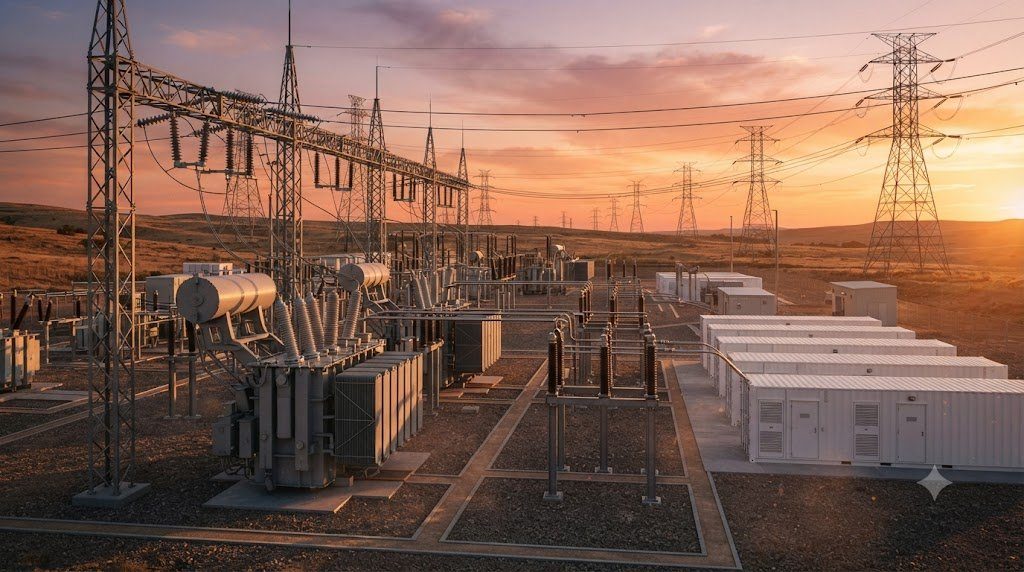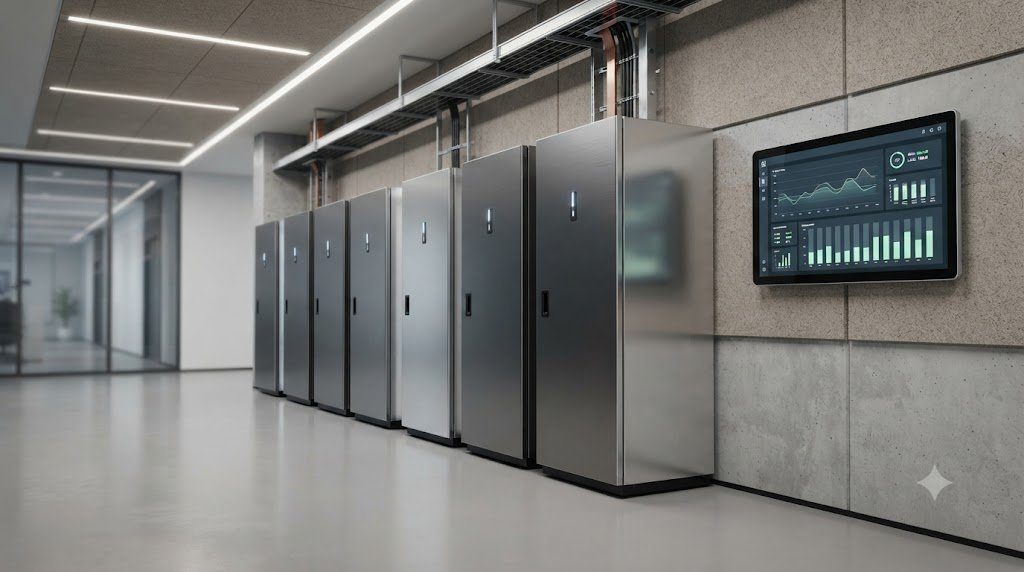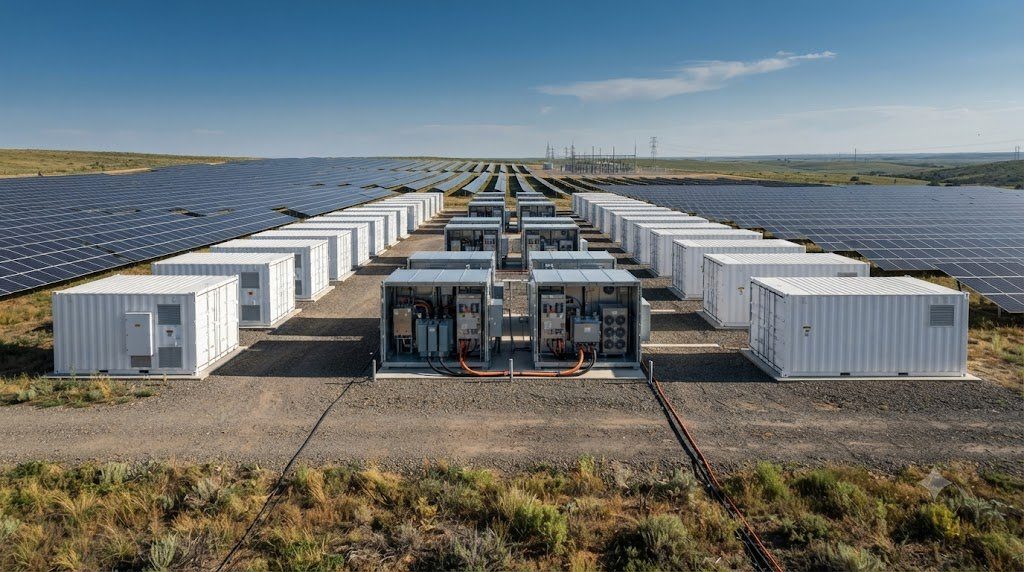
The worldwide transition from baseload fossil generation toward variable renewable energy sources—principally solar photovoltaic and wind farms—demands massive multi-hour electrical buffering at transmission scale. Utility-Scale Battery Energy Storage Systems (BESS) represent the backbone of the modern decarbonized power grid. From 20-foot and 40-foot containerized lithium battery architectures to bidirectional Power Conversion Systems (PCS), medium-voltage transformers, and computerized Energy Management Systems (EMS), utility BESS plants deploy hundreds of megawatts to stabilize wholesale electricity grids across the globe.
The Scale of Modern Utility BESS
Utility-scale battery installations are no longer experimental pilot projects. Premier installations—such as the 400 MW / 1,600 MWh Moss Landing facility in California or Australia’s Victorian Big Battery—deploy millions of lithium-ion cells organized into containerized enclosures capable of powering hundreds of thousands of homes for four continuous hours.
1. System Architecture: From Single Cell to Multi-Gigawatt Substation
A utility-scale BESS plant is a meticulously engineered hierarchical power plant structured across five physical hardware tiers:
- Tier 1: Battery Cells and Modules: Prismatic Lithium Iron Phosphate (LFP) cells (typically rated at 280 Ah to 314 Ah, 3.2V) are laser-welded in series into modules containing 16 to 52 cells, monitored by module-level Slave BMS boards.
- Tier 2: High-Voltage Battery Racks (Strings): Up to 8 to 12 modules connect in series inside a vertical steel rack enclosure, operating at nominal DC bus voltages between 1,000V and 1,500V DC with total string energy capacities of 200 kWh to 400 kWh.
- Tier 3: Standard ISO Containerized Enclosures: High-cube 20-foot or 40-foot shipping containers house 8 to 16 battery racks, complete with integrated liquid chilling loops, clean-agent fire suppression, aerosol gas venting, and Master BMS controllers, delivering 3.5 MWh to 5.0+ MWh per container.
- Tier 4: Power Conversion Systems (PCS / Inverters): Bidirectional 4-quadrant central or string inverters convert 1,500V DC power into 690V three-phase AC electricity with dynamic reactive power compensation.
- Tier 5: Medium-Voltage Substation Interconnection: Skid-mounted step-up transformers elevate 690V AC to distribution and transmission voltages (13.8 kV, 34.5 kV, up to 230 kV) through SF6 or vacuum circuit breakers tied into utility grid substations.
2. Chemistry Dominance: Why LFP Defeated NMC in Utility Storage
Between 2015 and 2020, early utility storage projects frequently utilized nickel-manganese-cobalt (NMC) chemistries due to their high volumetric energy density. Today, Lithium Iron Phosphate (LFP) commands over 95% of global utility installations:
| Performance Parameter | Lithium Iron Phosphate (LFP) | Nickel Manganese Cobalt (NMC 811) | Vanadium Redox Flow (VRFB) |
|---|---|---|---|
| Capital Cost ($/kWh DC) | Low ($90 – $130 / kWh) | Higher ($140 – $180 / kWh) | Very High ($350 – $600 / kWh) |
| Cycle Lifespan (80% SOH) | 6,000 – 10,000 cycles (15+ yrs) | 2,000 – 3,500 cycles (7-10 yrs) | 20,000+ cycles (Unlimited fade) |
| Thermal Runaway Threshold | High (270°C – 300°C) | Low (200°C – 210°C) | Immune (Aqueous liquid) |
| Thermal Oxygen Release | Zero (P-O covalent bonds do not release O2) | Severe (Layered oxide releases free O2) | None (Non-flammable liquid) |
| Round-Trip Efficiency (AC-AC) | 86% – 90% | 88% – 92% | 68% – 75% |
| Container Footprint (40ft) | 3.72 MWh – 5.0 MWh | 4.5 MWh – 6.0 MWh | Low (< 1.5 MWh + external tanks) |
3. Power Conversion Systems (PCS): Central vs. String Inverter Topologies
The Power Conversion System (PCS) is the bidirectional electronic heart that controls electrical flow between the DC battery racks and the AC utility grid:
Central Inverter Architecture
In central topologies, dozens of 1,500V DC battery racks connect in parallel to a massive shared DC busbar powering a single large central inverter rated at 2.5 MW to 4.0 MW. Central inverters offer lower capital expenditure (CapEx) per megawatt and higher peak conversion efficiency (> 98.8%). However, if one battery rack suffers capacity degradation or voltage mismatch, circulating loop currents develop between parallel strings, and an inverter failure takes the entire 4 MW block offline.
String Inverter (Distributed) Architecture
In modern modular designs, each individual battery rack (or pair of racks) connects to its own dedicated 150 kW to 250 kW string inverter. Each rack undergoes independent Maximum Power Point and State-of-Charge tracking, eliminating cross-string circulating currents and stranding zero capacity. If a single string inverter fails, 95% of the plant remains operational, maximizing availability in utility power purchase agreements (PPA).
4. Thermal Management Transitions: From Container HVAC to Rack Liquid Loops
Managing thermal uniformity across 10,000 high-capacity cells enclosed in a sun-baked desert shipping container represents an extreme engineering challenge:
Early BESS containers relied on industrial rooftop HVAC air-conditioners. Air cooling suffered notorious temperature disparities: cells adjacent to cold air blowers ran at 18°C, while cells nestled in rear corners reached 38°C. This 20°C gradient caused uneven aging, rapid string imbalance, and forced project de-rating. Modern utility storage containers integrate closed-loop liquid cold plates directly underneath or between cell modules, keeping cell-to-cell temperature deltas under ±2.5°C across the entire container while slashing auxiliary cooling power consumption by 35%.
5. The Multi-Tier Battery Management System (BMS) Architecture
Operating a 100 MW BESS safely requires a hierarchical digital control infrastructure:
- BMU (Battery Module Unit): Precision analog acquisition boards measuring cell voltages with millivolt accuracy and reading multiple NTC surface thermistors every 10 milliseconds.
- BCU (Battery Cluster / Rack Unit): High-voltage rack controller monitoring total string current via Hall-effect sensors, computing string State of Charge (SOC) and State of Health (SOH), and controlling high-voltage DC contactors and pyrotechnic fuses.
- BAU (Battery Array Unit / Master BMS): Aggregates data from all container racks, executing automated string balancing, insulation resistance detection (ground-fault monitoring), and communicating bidirectionally with the plant Energy Management System via industrial Modbus TCP/IP or IEC 61850 protocols.
6. Energy Management Systems (EMS) and Supervisory Control (SCADA)
While the BMS ensures physical safety, the Energy Management System (EMS) dictates financial dispatch and grid interaction:
The EMS interfaces directly with wholesale electricity market operators (such as CAISO, ERCOT, or PJM). Using AI-driven predictive algorithms that process real-time weather forecasts, locational marginal pricing (LMP), and grid frequency deviations, the EMS automatically decides millisecond-by-millisecond whether to charge from cheap mid-day solar power or discharge into high-value evening peak demand spikes, maximizing revenue across complex energy arbitrage and ancillary service contracts.
7. Round-Trip Efficiency (RTE) Degradation and Parasitic Auxiliary Loads
Evaluating utility BESS operational profitability requires tracking AC-to-AC Round-Trip Efficiency (RTE):
While DC battery cells achieve Coulombic efficiencies above 99% and DC energy efficiencies near 94%, total system-level AC-to-AC efficiency typically settles between 84% and 88% due to multiple real-world losses:
- Inverter bidirectional conversion losses (1.5% in each direction = ~3.0% total).
- Step-up transformer core and copper losses (~1.5% to 2.0%).
- Internal cabling and busbar resistive Joule losses (~1.0%).
- Auxiliary Parasitic Loads: Continuous 24/7 power consumed by liquid chillers, pumps, BMS controllers, fire safety sensors, and container lighting (accounting for 3% to 6% of total throughput).
8. Augmentation Strategies for 20-Year Project Lifecycles
Utility power purchase agreements and capacity supply contracts typically span 15 to 20 years, yet lithium cells degrade naturally over time:
To guarantee that a 100 MW / 400 MWh facility can deliver its full contracted 400 MWh rating in Year 15 without massive initial oversizing, developers execute scheduled battery augmentation. In Year 5 to Year 8, new containerized battery racks are connected to spare inverter DC ports or parallel AC transformers. Scheduled augmentation spreads capital expenditures over project lifespan and takes advantage of declining lithium battery prices ($/kWh) in future years.
9. Decommissioning, Second-Life Reuse, and Hydrometallurgical Recycling
At the end of a utility project’s operating life (when capacity fades below 60% to 70% SOH), responsible asset management mandates comprehensive circular economy protocols:
- Second-Life Repurposing: Retired utility cells can be tested, re-binned, and reassembled into lower-demand stationary applications, such as telecommunications backup power or agricultural water pumping systems.
- Hydrometallurgical Closed-Loop Recycling: Decommissioned modules undergo automated mechanical shredding under inert gas atmospheres, producing a concentrated “black mass”. Acid leaching and solvent extraction recover over 95% of high-purity lithium carbonate, copper, and aluminum, directly feeding raw materials back into gigafactory cathode supply chains.
10. Multi-Megawatt Substation Grid Interconnection and Islanding
Connecting a multi-hundred-megawatt storage plant to high-voltage transmission lines requires compliance with rigorous grid codes (such as IEEE 1547 and IEEE 2800):
Substation switchyards house medium-voltage vacuum breakers, sulfur hexafluoride (SF6) gas-insulated switchgear (GIS), and high-speed protective relaying systems. In the event of a regional blackout or transmission line trip, the BESS facility executes anti-islanding disconnection within 16 milliseconds to protect utility lineworkers, or switches seamlessly into microgrid islanding mode to maintain uninterrupted local municipal power.
11. Battery Degradation Modeling and Warranty Performance Ratios
Financing utility-scale battery assets requires bankable techno-economic models that accurately forecast electrochemical capacity fade over 20-year project horizons:
Asset managers utilize physics-informed semi-empirical degradation models that partition aging into two distinct components: calendar aging (driven by resting temperature and average state of charge) and cycling fatigue (driven by depth of discharge, charge throughput, and dynamic C-rate current stress). Long-term warranty performance contracts enforce strict Performance Guarantees (Energy Capacity Ratios and Round-Trip Efficiency thresholds). If battery racks degrade faster than agreed warranty curves, Original Equipment Manufacturers (OEMs) face substantial liquidated damages or must supply free replacement containers to keep plant capacity whole.
12. Frequently Asked Questions Regarding Utility-Scale BESS
What does BESS stand for in grid energy storage?
BESS stands for Battery Energy Storage System, a large-scale installation of rechargeable batteries used to store renewable energy and stabilize the power grid.
Why is LFP chemistry preferred over NMC for utility storage?
LFP offers much lower cost per kilowatt-hour, a cycle life of 6,000–10,000 cycles (vs. 2,500 for NMC), and superior thermal stability with zero oxygen release during overheating.
What is a Power Conversion System (PCS)?
The PCS is a bidirectional electrical inverter that converts direct current (DC) from battery racks into alternating current (AC) for the grid, and vice versa.
What is the typical voltage of a utility BESS battery rack?
Modern utility battery racks operate at nominal voltages between 1,000V and 1,500V DC to maximize inverter efficiency and minimize cable losses.
What is round-trip efficiency (RTE) in utility storage?
RTE is the percentage of electrical energy retrieved during discharge compared to the energy injected during charging, typically 85%–88% for liquid-cooled LFP systems.
What is the difference between central and string inverters in BESS?
Central inverters connect all battery racks to a single large 3 MW inverter; string inverters give each individual rack its own 200 kW inverter for independent control.
How much energy can fit inside a modern 20-foot storage container?
State-of-the-art 20-foot containerized enclosures house between 3.5 MWh and 5.0 MWh of liquid-cooled LFP battery storage.
What is battery augmentation in long-term utility projects?
Adding fresh battery containers in Year 5 or Year 8 to offset natural cell capacity degradation and maintain full contracted energy ratings over a 20-year term.
Why are BESS containers switching from HVAC to liquid cooling?
Liquid cooling eliminates 15°C temperature deltas across the pack, holds cell variations under 2.5°C, and slashes auxiliary power consumption by over 30%.
What is an Energy Management System (EMS)?
The high-level software that forecasts market prices, monitors weather, and autonomously commands the BESS to charge or discharge to maximize revenue.
What happens to utility battery cells when they reach end of life?
Cells are shredded to produce black mass, from which hydrometallurgical recycling plants recover over 95% of raw lithium, copper, and aluminum.
How quickly can a utility BESS respond to grid commands?
Modern inverter-based BESS can ramp from full zero to maximum megawatt discharge in under 20 to 50 milliseconds, vastly faster than gas turbines.
What is the typical warranty term for a utility battery installation?
Leading energy storage manufacturers provide 10-to-15-year standard performance warranties, with available capacity maintenance agreements extending coverage to 20 years.
How does humidity and salt mist affect coastal BESS projects?
Coastal installations utilize C5-M marine-grade anti-corrosion container coatings, sealed NEMA 4X enclosures, and desiccant dehumidifiers to protect internal electronics.
What is the typical auxiliary power consumption of a utility BESS container?
Auxiliary loads from liquid chillers, pumps, BMS controllers, and safety circuits typically consume between 2% and 4% of total energy throughput depending on ambient weather conditions.