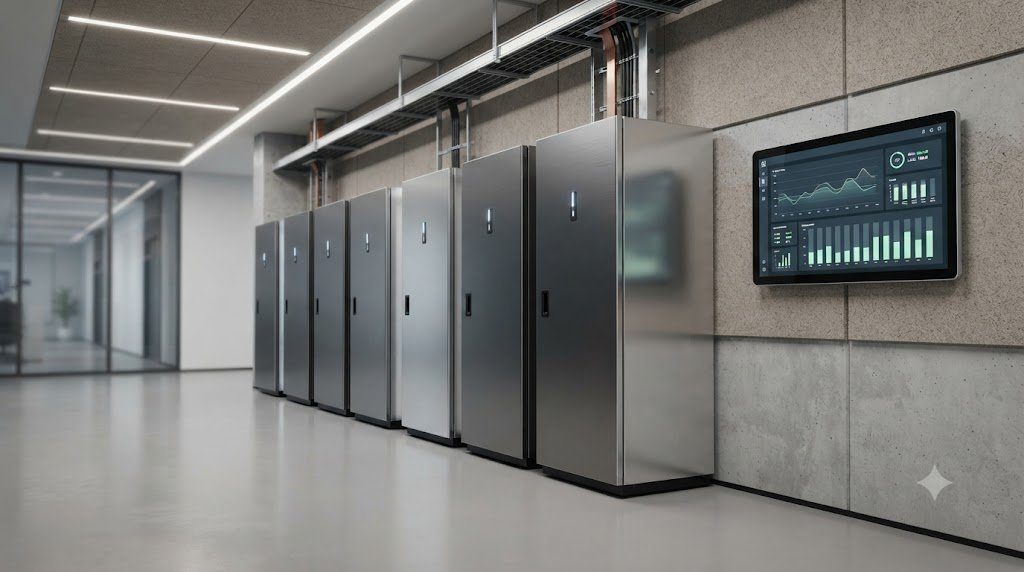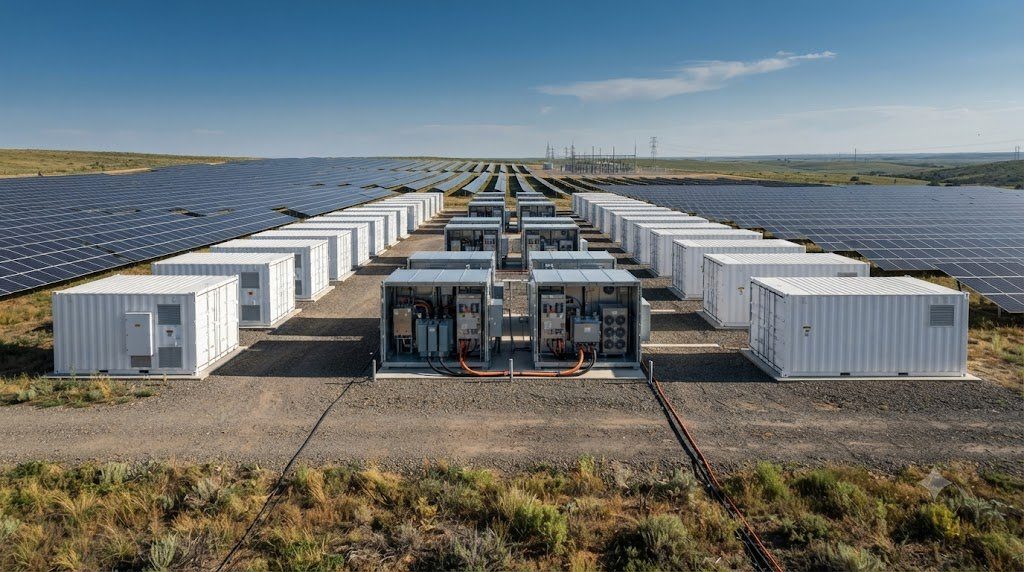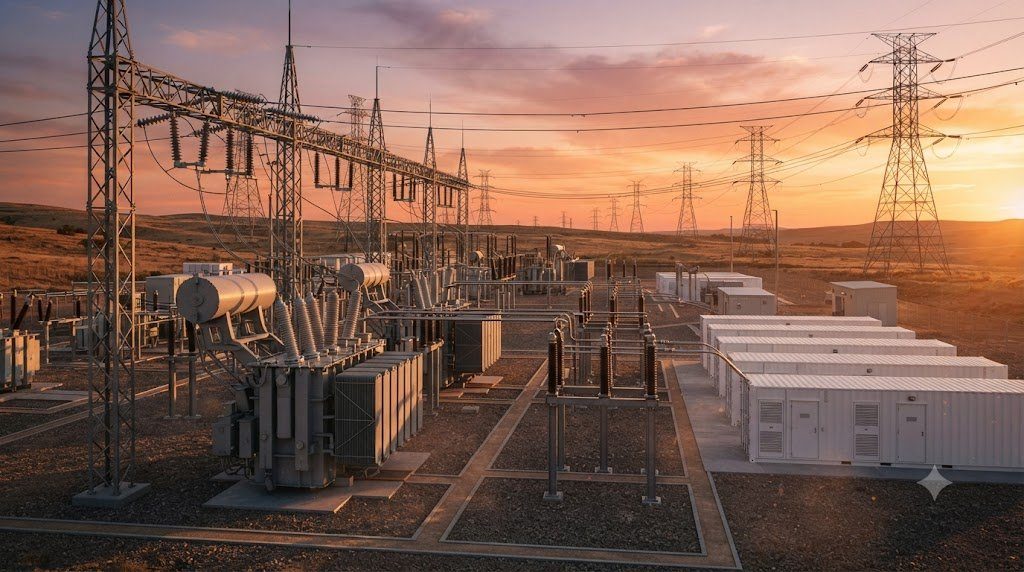
As traditional thermal generation stations—coal-fired boilers and open-cycle natural gas turbines—are retired in favor of inverter-based renewable generation, electrical power grids face unprecedented stability crises: collapsing system inertia, rapid rate of change of frequency (RoCoF), and severe local voltage volatility. Battery Energy Storage Systems (BESS) have evolved far beyond mere bulk kilowatt-hour time-shifting. Operating with millisecond response kinetics, modern grid-connected batteries deliver sophisticated ancillary grid services: Primary Frequency Response (PFR), Fast Frequency Response (FFR), Synthetic / Virtual Inertia emulation, dynamic reactive voltage support, and critical post-blackout Black Start capability.
The Speed Advantage of Inverter-Based Storage
A conventional thermal peaking gas turbine requires 10 to 15 minutes to fire up, synchronize, and ramp to full power in response to a sudden grid contingency. In stark contrast, a modern lithium-ion BESS with advanced four-quadrant inverters can detect a grid frequency collapse and inject hundreds of megawatts of active power in under 20 to 50 milliseconds—three hundred times faster than mechanical combustion engines.
1. Grid Frequency Mechanics: The Rotational Inertia Deficit
In any alternating current electrical grid, system frequency (50.0 Hz in Europe/Asia, 60.0 Hz in North America) serves as the instantaneous pulse of the entire interconnected network. System frequency is directly proportional to the rotational mechanical speed of massive synchronized turbine rotors spinning in synchronous power plants:
- The Mechanical Balance: When electrical generation exactly equals consumer electrical load, frequency sits locked at 60.000 Hz. If a major 1,000 MW nuclear reactor or transmission intertie suddenly trips offline, electrical load instantaneously exceeds generation. The deficit is momentarily supplied by the physical kinetic energy stored in spinning turbine rotors, causing them to decelerate. As turbines slow, grid frequency plummets.
- The Inverter Problem: Solar photovoltaic panels and wind turbines connect to the grid via digital DC-to-AC inverters that possess zero physical rotating mass. As renewable penetration climbs to 60%, 80%, or 100%, total system physical inertia collapses. When a contingency occurs on a low-inertia grid, the Rate of Change of Frequency ($df/dt$, or RoCoF) accelerates wildly, risking cascade trips of under-frequency load shedding (UFLS) relays and triggering regional blackouts within seconds.
2. Fast Frequency Response (FFR) and Primary Frequency Control
To prevent catastrophic frequency collapse, grid operators contract high-speed Fast Frequency Response (FFR) from battery storage assets:
BESS controllers continuously monitor grid AC voltage cycles via high-precision Phasor Measurement Units (PMUs) sampling thousands of times per second. Battery response follows an engineered frequency-droop control curve:
- Deadband Operation: Under normal conditions within the deadband (e.g., 59.96 Hz to 60.04 Hz), the battery remains idle or performs standard market arbitrage.
- Under-Frequency Injection: The instant frequency drops below 59.96 Hz, the battery ramps active discharge power instantaneously, reaching 100% full megawatt output in under 200 milliseconds. This lightning injection arrests the frequency decline (the “frequency nadir”), buying time for slower hydro and gas generators to spin up.
- Over-Frequency Absorption: Conversely, if sudden transmission load shedding causes frequency to surge above 60.04 Hz, the BESS instantly switches to charging mode, absorbing excess energy from the grid to clamp frequency back to 60.0 Hz.
| Grid Service / Ancillary Product | Response Time Scale | Governing Physical Mechanism | BESS Operational Role | Market Revenue Potential |
|---|---|---|---|---|
| Synthetic / Virtual Inertia | < 20 – 50 milliseconds | Grid-forming voltage source instantaneous response | Emulates spinning kinetic mass, dampens RoCoF | Emerging premium capacity markets |
| Fast Frequency Response (FFR) | 100 ms – 1.0 second | Fast frequency-droop proportional control | Arrests frequency nadir following major plant trip | Very High (Ancillary service auctions) |
| Primary Frequency Response (PFR) | 1.0 – 4.0 seconds | Governor droop emulation | Stabilizes frequency at interim plateau | High (Standard reliability compliance) |
| Secondary Regulation (AGC) | 4 seconds – 5 minutes | Central automated generation control dispatch | Restores frequency back to exact 60.000 Hz | Consistent continuous monthly revenue |
| Voltage Support (VARs) | < 20 milliseconds | Four-quadrant reactive power injection/absorption | Controls local substation voltage within ±5% | Bilateral utility reliability contracts |
| Black Start Restoration | Minutes to hours | Grid-forming voltage generation + inrush energization | Bootstraps collapsed grid without external power | Lucrative standby reservation retainers |
3. Grid-Following (GFL) vs. Grid-Forming (GFM) Inverter Physics
The most profound paradigm shift in modern electrical engineering is the transition from Grid-Following (GFL) to Grid-Forming (GFM) inverters:
Grid-Following Inverters (Current Sources)
Historically, 99% of solar and battery inverters were engineered as grid-following devices. A GFL inverter utilizes a mathematical Phase-Locked Loop (PLL) to track the existing grid voltage vector ($V ngle heta$) established by conventional rotating generators. The inverter acts as a regulated current source, injecting alternating current into the pre-existing voltage grid. However, if renewable penetration pushes the grid into a “weak grid” condition (Short Circuit Ratio – SCR < 1.5), the PLL loses synchronization, becomes unstable, and trips offline, triggering catastrophic regional blackout collapses.
Grid-Forming Inverters (Voltage Sources)
In contrast, Grid-Forming (GFM) inverters do not rely on an external grid voltage reference; they act as an independent, stiff ac voltage source behind a virtual impedance ($E ngle \delta$):
- Using Virtual Synchronous Machine (VSM) or Droop Control algorithms, GFM inverters dictate the voltage magnitude and phase angle directly.
- When a grid disturbance occurs, the phase angle differential ($E ngle \delta$ vs. $V_{grid} ngle heta$) changes instantaneously according to physical Ohm’s law, causing the inverter to naturally inject or absorb active power in zero milliseconds—providing genuine synthetic inertia with zero digital PLL calculation delays!
4. Synthetic / Virtual Inertia: Emulating Heavy Turbine Mechanics
To mathematically replace the physical inertia lost when coal generators shut down, grid-forming battery systems execute Synthetic Inertia emulation:
The inverter software emulates the classic mechanical Swing Equation of a synchronous generator rotor:
Here, $H$ is the virtual inertia constant (typically engineered between 2.0 and 6.0 seconds), and $D$ is the damping factor. By releasing electrical energy proportional to the derivative of frequency ($df/dt$), the battery acts as an invisible 500-ton spinning steel rotor, mechanically dampening grid frequency volatility across transmission networks.
5. Dynamic Reactive Power (VAR) and Voltage Regulation
High-voltage transmission grids do not only require active power (Watts); they require continuous reactive power (Volt-Amperes Reactive – VARs) to maintain bus voltage stability within strict regulatory statutory limits (±5% nominal voltage):
- Four-Quadrant Inverter Capabilities: The bidirectional PCS can operate anywhere in the four P-Q quadrants, independently commanding active power ($P$) and reactive power ($Q$). Even when the battery cells are completely idle or fully charged, the inverter can continuously provide pure reactive power.
- Capacitive vs. Inductive Voltage Clamping: When heavy industrial inductive motor loads cause local substation voltage to sag, the BESS injects leading reactive power (capacitive mode) to boost voltage. When long, lightly loaded transmission lines cause voltage to spike (the Ferranti effect), the BESS absorbs reactive power (inductive mode) to pull voltage back into safe operating bounds, completely replacing obsolete mechanical synchronous condensers.
6. Black Start Capability: Bootstrapping a Collapsed Power Grid
In the catastrophic event of a total system-wide regional blackout, conventional thermal power plants cannot restart on their own. They require massive megawatts of external electrical power to spin boiler feed pumps, drive forced-draft cooling fans, and energize exciter windings:
Traditionally, black-start services were provided by polluting diesel generators or remote hydroelectric dams. Today, Grid-Forming BESS plants serve as the ultimate Black Start anchor:
- Zero-Voltage Substation Energization: Starting with completely de-energized switchyards, the grid-forming BESS ramps its output voltage smoothly from 0V up to full 34.5 kV, energizing medium-voltage step-up transformers with zero destructive inrush magnetizing currents.
- Transmission Line Charging: The BESS energizes kilometers of high-voltage transmission lines, absorbing large capacitive charging currents without tripping.
- Thermal Plant Cranking: The battery delivers 20 to 50 MW of clean, stable power to crank heavy startup motors at neighboring combined-cycle gas turbine facilities, bootstrapping the regional power grid back to full operational status in record time.
7. Secondary Frequency Regulation and Automated Generation Control (AGC)
While fast frequency response operates autonomously within milliseconds, Secondary Regulation operates on a 4-second continuous loop governed by the regional transmission operator’s (RTO) supercomputers:
The grid operator transmits digital Automated Generation Control (AGC) dispatch signals every two to four seconds (such as PJM’s RegD fast regulation signal). Battery assets track these rapidly fluctuating setpoints with near 100% accuracy scores, constantly cycling between micro-charges and micro-discharges to trim minor area control errors (ACE) and bring system frequency back to precisely 60.000 Hz, commanding lucrative premium regulation market clearing prices.
8. Transmission Deferral and Virtual Power Plant (VPP) Aggregation
Beyond localized substation services, distributed battery systems are revolutionizing transmission utility planning through Virtual Power Plant (VPP) aggregation:
Instead of spending $200 million building a new 50-mile overhead transmission line to serve a congested urban load center, utilities deploy stationary BESS at congested substation nodes. During peak summer transmission bottlenecks, the battery injects power locally, eliminating line overloading—a strategy known as Non-Wires Alternatives (NWA) or Transmission Deferral. Simultaneously, cloud-based VPP software aggregates thousands of distributed residential and commercial batteries, dispatching them collectively as a single, coordinated 100 MW power plant to provide grid-scale ancillary services.
9. Operational Degradation Costs: C-Rate Stress vs. Ancillary Market Profits
Providing aggressive grid services involves real electrochemical degradation trade-offs:
Participating in continuous high-rate frequency regulation subjects battery cells to thousands of micro-cycles per day at rates up to 1C to 2C. While total throughput energy may be modest, high C-rate bursts induce mechanical stress at active particle interfaces and accelerate SEI layer growth. Sophisticated asset managers enforce multi-objective optimization algorithms: the EMS continuously calculates the marginal financial revenue of bidding into frequency regulation against the marginal electrochemical cost of cell degradation ($/kWh fade), ensuring assets only dispatch when market clearing prices substantially exceed degradation costs.
10. Frequently Asked Questions Regarding BESS Grid Services
What is grid frequency and why must it stay at 60 Hz or 50 Hz?
Grid frequency reflects the balance between electrical generation and load; any mismatch causes turbines to speed up or slow down, and severe frequency deviations can trigger widespread blackouts.
How does a battery provide synthetic or virtual inertia?
Grid-forming inverters emulate the physics of spinning turbine mass by automatically injecting or absorbing electrical power in response to frequency changes with zero time delay.
What is the difference between grid-following and grid-forming inverters?
Grid-following inverters require an existing grid voltage to follow as current sources; grid-forming inverters create their own stable voltage waveform and act as independent voltage sources.
What is Fast Frequency Response (FFR)?
Injecting full rated megawatt power in under 200 milliseconds when grid frequency collapses, arresting the decline before emergency load shedding relays trip.
What is Black Start capability in battery storage?
The ability of a battery system to energize a completely dead, blacked-out electrical grid from scratch without relying on external power.
Can a battery provide reactive power (VARs) when not discharging energy?
Yes, four-quadrant bidirectional inverters can inject or absorb reactive power to regulate voltage even when battery cell active power output is zero.
What is Automated Generation Control (AGC)?
A digital command loop sent by grid operators every 2 to 4 seconds that instructs batteries to ramp up or down to correct real-time supply and demand mismatches.
What are Non-Wires Alternatives (NWA)?
Using battery storage to relieve local transmission line bottlenecks, avoiding the multi-million-dollar cost of building new physical power lines.
Why is battery response superior to traditional gas peakers for grid stability?
Batteries respond in under 50 milliseconds, whereas natural gas turbines take 10 to 15 minutes to synchronize and ramp up.
What is a Virtual Power Plant (VPP)?
A cloud-based network of thousands of distributed home and commercial batteries aggregated and dispatched collectively as a single utility-scale power plant.
What is frequency-droop control?
A proportional control algorithm where the battery adjusts its power output linearly based on how far grid frequency deviates from nominal 60.0 Hz.
Does providing frequency regulation shorten battery life?
Continuous high-rate micro-cycling increases mechanical particle stress and SEI growth, which asset managers balance against lucrative ancillary service revenue.
What is the difference between primary and secondary frequency response?
Primary response is autonomous and instantaneous (milliseconds to seconds); secondary response is centrally commanded by grid operators over 4-second to 5-minute loops.
How do grid-forming batteries prevent weak-grid voltage collapse?
By acting as low-impedance voltage sources that anchor local AC voltage magnitude and phase, maintaining grid stability even with Short Circuit Ratios below 1.5.