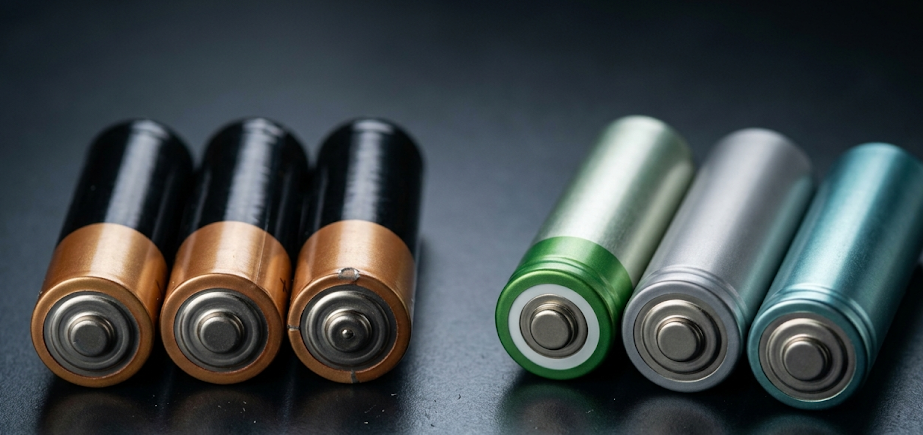
Nickel-based alkaline rechargeable batteries, including Nickel-Cadmium (NiCd), Nickel-Metal Hydride (NiMH), and Nickel-Iron (NiFe), represent one of the most durable, resilient, and historically pivotal classes of electrochemical energy storage. From powering early portable consumer electronics, satellites, and hybrid electric vehicles like the seminal Toyota Prius, to safeguarding critical aerospace avionics and railway signaling, nickel chemistries exhibit remarkable structural tolerance against overcharging, deep discharge, and extreme operational temperatures that would destroy sensitive lithium-ion cells.
Electrochemical Fundamental: Alkaline Hydroxide Shuttling
Unlike acidic lead systems or organic lithium electrolytes, nickel batteries utilize an aqueous alkaline electrolyte—predominantly concentrated potassium hydroxide ($KOH$). The electrolyte acts as a purely catalytic ionic conductor for hydroxide ions ($OH^-$), meaning electrolyte concentration remains virtually constant during charge and discharge cycles.
1. Nickel-Cadmium (NiCd): Chemistry, Plate Design, and the Memory Effect
Invented by Waldemar Jungner in 1899, the Nickel-Cadmium cell couples a nickel hydroxide ($NiOOH$) positive cathode with an elemental cadmium ($Cd$) negative anode immersed in a 20% to 30% aqueous potassium hydroxide ($KOH$) electrolyte with lithium hydroxide ($LiOH$) additives to improve high-temperature cycling.
The fundamental electrochemical reactions are governed by the following redox couple:
ext{Negative Plate:} Cd + 2OH⁻ ⇌ Cd(OH)₂ + 2e⁻ (E° = -0.81 V vs SHE)
Combining both yields the complete cell reaction:
The True ‘Memory Effect’ (Voltage Depression)
NiCd batteries became infamous for the memory effect, scientifically termed voltage depression. When a NiCd cell is repeatedly discharged to the exact same partial depth of discharge (e.g., 25% DoD) and recharged without periodic full discharge, uncycled cadmium active material crystallizes into dense, large $\gamma$-phase crystals with low surface area. Upon demanding full capacity, these coarse crystals create high internal resistance, causing the cell discharge voltage curve to drop prematurely below 1.0V. The energy is not truly lost; rather, the cell voltage drops below the low-voltage threshold of the host electronic circuit. Complete discharge down to 1.0V/cell (reconditioning) dissolves the coarse cadmium morphology and fully restores nominal capacity.
2. Nickel-Metal Hydride (NiMH): Hydrogen Storage Alloys and Modern Hybrids
To eliminate toxic cadmium heavy metals and boost volumetric energy density, engineers developed Nickel-Metal Hydride (NiMH) in the late 1980s. In NiMH, the toxic cadmium anode is replaced by an intermetallic hydrogen storage alloy capable of reversibly absorbing and releasing atomic hydrogen like a molecular sponge.
The anode reaction utilizes an alloy matrix, designated as $M$:
Modern NiMH negative electrodes predominantly utilize two classes of intermetallic metal alloys:
- $AB_5$ Alloys: Rare-earth mischmetal alloys where $A$ consists of lanthanum, cerium, or neodymium, and $B$ consists of nickel alloyed with cobalt, manganese, or aluminum (e.g., $LaNi_5$). These alloys powered millions of Toyota Prius hybrid traction battery packs across decades of legendary reliability.
- $AB_2$ Alloys: Laves-phase titanium-zirconium-vanadium alloys (e.g., $TiMn_2$, $ZrNi_2$). While offering higher gravimetric hydrogen storage capacities, $AB_2$ alloys exhibit slower activation kinetics and higher corrosion susceptibility in alkaline $KOH$.
Low Self-Discharge (LSD) NiMH Innovation
Traditional NiMH cells suffered from high self-discharge, losing 20% to 30% of their charge within the first month due to micro-impurity shuttling across the separator. In 2005, Sanyo introduced the Eneloop low self-discharge (LSD) architecture. By utilizing superlattice alloy formulations, ultra-dense sulfonated polyolefin separators, and optimizing nickel current collectors, LSD NiMH cells retain over 70% to 85% of their charge after 5 to 10 years of shelf storage, making them direct drop-in replacements for disposable alkaline 1.5V AA/AAA cells.
3. Nickel-Iron (NiFe): The Indestructible Edison Battery
Patented by Thomas Edison in 1901, the Nickel-Iron (NiFe) alkaline battery is renowned as the most mechanically and electrochemically indestructible battery ever commercialized. Featuring nickel-plated steel perforated pocket plates containing nickel hydroxide positive mass and elemental iron ($Fe$) negative active mass, NiFe batteries tolerate operational abuse that destroys all other technologies:
- Extreme Service Life: Operating operational lifespans routinely exceed 30 to 50+ years, with thousands of continuous cycles.
- Total Abuse Tolerance: NiFe cells can be completely discharged to 0.0 volts, short-circuited, left uncharged for decades, or subjected to continuous overcharging without permanent structural damage.
- Trade-offs: NiFe suffers from low energy density (30–50 Wh/kg), low round-trip energy efficiency (typically 65% to 70% due to continuous hydrogen evolution on the iron electrode), high self-discharge, and high manufacturing cost, limiting modern adoption to robust off-grid solar homesteads and heavy underground rail transport.
| Chemistry | Nominal Cell Voltage | Specific Energy (Wh/kg) | Cycle Life (80% DoD) | Self-Discharge Rate | Key Modern Applications |
|---|---|---|---|---|---|
| Nickel-Cadmium (NiCd) | 1.20 V | 45 – 60 Wh/kg | 1,500 – 2,500 cycles | 10 – 15% per month | Aviation emergency power, railway signaling, oil & gas UPS |
| Nickel-Metal Hydride (NiMH) | 1.25 V | 60 – 120 Wh/kg | 500 – 1,000 cycles (2,000+ for LSD) | 1 – 3% per month (LSD type) | HEVs (Toyota Prius), consumer electronics (AA/AAA), medical |
| Nickel-Iron (NiFe) | 1.20 V | 30 – 55 Wh/kg | 3,000 – 5,000+ cycles (30+ yrs) | 20 – 30% per month | Remote off-grid homesteads, rugged telecom, mining locomotives |
| Nickel-Zinc (NiZn) | 1.65 V | 70 – 90 Wh/kg | 300 – 600 cycles | 10 – 12% per month | High-drain power tools, municipal traffic signals, high-voltage UPS |
4. Thermal Management and Negative Delta-V (-ΔV) Charge Termination
Charging nickel-based batteries requires sophisticated algorithmic control due to their unique electrochemical behavior during overcharge. Unlike lithium-ion cells which exhibit a sharp voltage spike at full charge, NiCd and NiMH cells undergo an exothermic oxygen recombination reaction near 100% state of charge.
As oxygen recombines at the negative plate, intense localized heat is generated. Because the electrochemical potential of nickel batteries has a negative temperature coefficient, this sudden temperature spike causes cell internal impedance to fall, resulting in a distinct, measurable voltage drop at the battery terminals despite continuous current flow.
Advanced intelligent chargers monitor terminal voltage at millivolt resolutions to execute negative delta-V (-ΔV) cut-off:
- For NiCd Cells: A sharp voltage drop of -10 to -20 mV per cell signals 100% saturation and triggers immediate charge termination.
- For NiMH Cells: NiMH exhibits a much subtler voltage drop, typically only -4 to -8 mV per cell (and almost zero drop at low charging rates below 0.5C). Therefore, smart NiMH chargers employ dual-redundant safety cut-offs, coupling $-ΔV$ with rate-of-temperature-rise (dT/dt ≥ 1°C/min) and absolute temperature caps ($T_{max} \le 55^\circ ext{C}$).
6. Aviation and Industrial Applications: Sintered Plate Robustness
In commercial aviation (Boeing 737, Airbus A320) and military jet fighters, flight certification rules mandate onboard emergency power sources capable of delivering immense discharge bursts under severe freezing temperatures (-40°C) without risk of internal circuit freezing or sudden thermal runaway shutdown. For these mission-critical applications, sintered-plate or fiber-structure Nickel-Cadmium batteries remain universally standard:
- Sintered Carbonyl Nickel Matrix: Active material is electrochemically impregnated into a porous matrix of sintered carbonyl nickel powder sintered onto nickel mesh screens. This yields an exceptionally thin, ultra-high surface area electrode capable of discharging at continuous 10C rates and short-duration 30C bursts to start Auxiliary Power Units (APUs) in sub-zero tropospheric environments.
- Aqueous Electrolyte Non-Freezing Properties: Concentrated 30% potassium hydroxide electrolyte maintains high ionic conductivity down to -50°C and does not suffer the catastrophic freezing risks of discharged lead-acid systems, ensuring instantaneous hydraulic and avionic backup power during in-flight generator emergencies.
7. Reconditioning Cycles and Deep Discharge De-Crystallization Protocols
To combat voltage depression and restore full amp-hour reserve capacity in industrial NiCd and NiMH battery banks, technicians utilize automated reconditioning cycles:
The battery is subjected to a deep, controlled constant-current discharge down to exactly 1.00V per cell (and down to 0.4V to 0.6V per individual cell using resistor load banks in specialized maintenance shops). This deep exhaustion forcibly drives the recrystallization of dense, passive $\gamma$-phase cadmium crystals back into high-surface-area micro-crystalline structures. Following this exhaustion, a calibrated 16-hour constant-current charge at 0.1C ($C/10$) restores uniform state-of-charge equilibrium across all series-connected cells without generating destructive thermal runaway heat.
8. Life Cycle Analysis and Environmental Stewardship
From an environmental lifecycle perspective, the nickel battery family presents contrasting profiles:
While cadmium recycling is strictly mandated under hazardous waste regulations (recovering 99% pure cadmium metal through vacuum distillation in closed pyrometallurgical retorts), NiMH batteries represent a completely non-toxic, environmentally benign consumer storage media. Spent NiMH packs are recycled for their high nickel content (which accounts for over 35% to 50% of cell mass) and valuable rare-earth elements (lanthanum, cerium, neodymium), which are reprocessed into stainless steel master alloys and high-performance magnets.
9. Toyota Hybrid Synergy Drive: Thermal and BMS Longevity Strategies
The extraordinary commercial longevity of Nickel-Metal Hydride batteries in Toyota Prius and Lexus hybrid vehicles—frequently operating beyond 300,000 miles without pack replacement—is not merely a product of chemistry, but of masterclass Battery Management System (BMS) operational discipline:
- The Restricted State-of-Charge Window (40% to 80% SoC): Unlike consumer smartphones that cycle lithium cells between 0% and 100%, Toyota hybrid controllers strictly restrict NiMH cycling to a narrow 40% to 80% SoC band (hovering around a nominal 60% equilibrium point). Operating exclusively within this linear electrochemical zone prevents both high-voltage oxygen recombination stress and low-voltage reverse cell polarity damage.
- Forced-Air Thermal Envelope Control: Because NiMH charge acceptance degrades rapidly above 45°C, vehicle cabin air is actively pulled across individual prismatic 7.2V module channels via dedicated multi-speed brushless blower fans. If module temperature sensors register thermal gradients exceeding 5°C between center and edge modules, the ECU automatically limits regenerative braking current to prevent localized cell degradation.
- Automated Equalization via Trickle Saturation: Periodically, when the vehicle descends long mountain passes, the hybrid management system allows the NiMH pack to absorb extended low-current regenerative charging up to 85% SoC. This gentle overcharge generates mild oxygen recombination that passively equalizes series module capacities without inducing destructive thermal runaway.
10. Frequently Asked Questions Regarding Nickel Batteries
What is the nominal voltage of a standard NiMH or NiCd cell?
The nominal voltage is 1.2 volts per cell. When fully charged under open circuit, they measure approximately 1.40V to 1.45V, discharging down to 1.0V.
Does the ‘memory effect’ affect NiMH batteries?
True memory effect affects NiCd batteries. NiMH batteries can experience mild voltage depression under repetitive partial cycling, but it is far less severe and reversible with a full discharge cycle.
What is a Low Self-Discharge (LSD) NiMH battery?
LSD NiMH batteries (like Panasonic Eneloop) use improved separators and alloy grids that reduce charge leakage, allowing them to retain 70-85% capacity after years on the shelf.
How does negative delta-V (-ΔV) charging work?
Near full charge, oxygen recombination produces heat, which lowers cell internal resistance and causes terminal voltage to drop slightly. Smart chargers detect this drop and terminate charging.
Why did the Toyota Prius use NiMH batteries for so many generations?
NiMH provided exceptional safety, tolerance to thousands of shallow cycles in the 40-80% SoC window, wide operating temperature range, and decades of proven mechanical robustness.
What is a Nickel-Iron (Edison) battery?
A nickel-iron battery is an alkaline battery invented by Thomas Edison that uses nickel oxide and iron plates in KOH. It is famous for lasting over 30 to 50 years under extreme abuse.
Why can’t NiCd batteries be disposed of in standard household trash?
NiCd batteries contain toxic cadmium metal which bioaccumulates in soils and groundwater, posing severe toxicological risks to human health.
Can a NiMH charger charge NiCd batteries safely?
Generally yes, because NiCd produces a more pronounced -ΔV signal. However, a pure NiCd charger should NOT be used for NiMH, as it may miss the smaller NiMH -ΔV signal and overheat the cell.
What is the electrolyte used in nickel batteries?
They use an aqueous solution of potassium hydroxide (KOH), typically 20% to 30% concentration, with added lithium hydroxide to boost high-temperature cycling.
What is Nickel-Zinc (NiZn) and why isn’t it widely used?
NiZn offers high voltage (1.65V/cell) and good power density, but historically suffered from severe zinc dendrite growth that caused internal short circuits and short cycle life.