Redox Flow Batteries (RFBs), spearheaded by all-vanadium and zinc-bromine chemistries, represent the definitive electrochemical frontier for long-duration stationary energy storage (LDES). As renewable wind and solar generation penetrate electrical grids, utility operators face multi-hour and multi-day intermittency gaps that exceed the economical 2-to-4-hour duration of lithium-ion systems. Flow batteries solve this fundamental bottleneck by completely decoupling power capacity (kilowatts) from energy capacity (kilowatt-hours) through liquid electrolyte storage in external atmospheric tanks.
The Core Flow Battery Paradigm: Power vs. Energy Decoupling
In conventional closed-cell batteries (such as lithium-ion or lead-acid), power and energy are physically bound within the same electrode package. In a redox flow battery, power is determined strictly by the surface area of the membrane stack, while energy capacity is determined solely by the volume and molarity of the liquid electrolyte stored in external tanks.
1. System Architecture: Decoupling Power and Energy Capacities
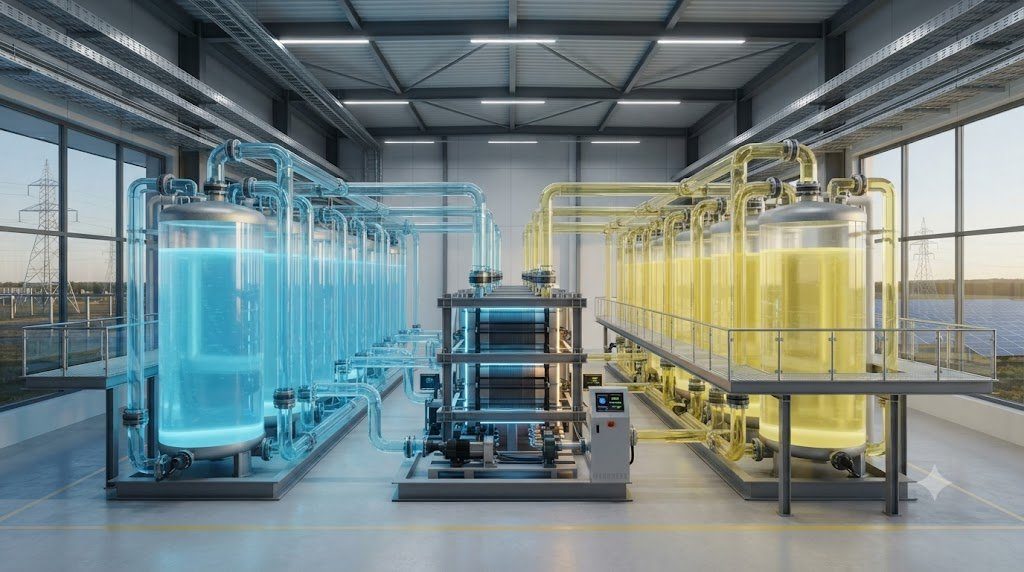
A Redox Flow Battery system consists of three primary functional engineering subsystems:
- The Cell Stack (Power Subsystem): Multiple individual electrochemical cells connected electrically in series and hydraulically in parallel. Each cell comprises two carbon felt porous electrodes separated by an ion-exchange membrane (typically Nafion or hydrocarbon membranes), sandwiched between conductive carbon composite bipolar plates. Stack area ($m^2$) dictates total power output in megawatts ($MW$).
- Electrolyte Storage Tanks (Energy Subsystem): Two large, atmospheric-pressure chemical tanks storing the positive electrolyte (catholyte) and negative electrolyte (anolyte). Expanding energy capacity from 4 hours to 12 or 24 hours of duration requires simply constructing larger poly-lined tanks and pouring in more liquid solution, costing a fraction of lithium cell duplication.
- Hydraulic Balance of Plant (BoP): Chemical circulating pumps, piping manifolds, flow meters, heat exchangers, and pulse dampers that continuously circulate liquid electrolyte from tanks through the active cell stacks during charge and discharge cycles.
2. Vanadium Redox Flow Batteries (VRFB): Pure Single-Element Elegance
Pioneered by Professor Maria Skyllas-Kazacos at the University of New South Wales in the 1980s, the All-Vanadium Redox Flow Battery (VRFB) is the undisputed commercial gold standard among flow technologies. Its extraordinary commercial advantage stems from utilizing vanadium ions across four different oxidation states in both half-cells, completely eliminating cross-contamination degradation:
ext{Negative Anode Reaction:} V³⁺ + e⁻ ⇌ V²⁺ (V³⁺ o V²⁺, E° = -0.26 V)
The complete cell reaction yields a standard cell voltage of approximately 1.26 V at 50% SoC (operational range 1.15V to 1.55V). In standard formulations, vanadium pentoxide ($V_2O_5$) is dissolved in concentrated aqueous hydrochloric or sulfuric acid ($H_2SO_4$, 2–4 M) alongside stabilizing additives.
Elimination of Membrane Crossover Degradation
In multi-element flow batteries (like iron-chromium), active metal ions gradually permeate across the microscopic pore channels of the membrane separator, permanently contaminating the opposing electrolyte and causing irreversible capacity loss. In a VRFB, because vanadium exists on both sides of the membrane, any vanadium ion that crosses over does not introduce a foreign chemical poison. It merely shifts the oxidation state balance, which can be 100% restored through periodic hydraulic electrolyte rebalancing or minor electrochemical electrolysis. Consequently, the liquid electrolyte in a VRFB exhibits a theoretically infinite operational lifespan, retaining full monetary residual value indefinitely.
3. Alternative Chemistries: Zinc-Bromine, Iron-Chromium, and All-Iron
Beyond all-vanadium systems, several competing redox couples have reached commercial pilot installations:
Zinc-Bromine Hybrid Flow Batteries (Zn-Br)
Unlike pure liquid VRFBs, Zinc-Bromine is a hybrid flow battery. During charge, metallic zinc plates out as a solid electrodeposit on the negative carbon electrode, while bromide ions oxidize into elemental bromine ($Br_2$) at the positive electrode, complexed with quaternary ammonium salts into a dense, oily phase. Zn-Br systems achieve higher cell voltage (1.82V) and higher energy density (60–80 Wh/kg), but suffer from zinc dendrite piercing risks, self-discharge from bromine crossover, and the physical limitation of plate thickness capacity saturation.
All-Iron Flow Batteries (Fe-Fe)
Utilizing earth-abundant, ultra-low-cost iron salts ($FeCl_2$), all-iron systems cycle between $Fe^0
ightleftharpoons Fe^{2+}$ plating at the negative electrode and $Fe^{2+}
ightleftharpoons Fe^{3+}$ at the positive electrode. While completely non-toxic and free from expensive critical minerals, all-iron cells struggle with hydrogen gas evolution side-reactions at the negative electrode and lower round-trip energy efficiency (60–68%).
| Flow Chemistry | Cell Voltage | Energy Density (Wh/L) | Electrolyte Lifespan | Round-Trip Efficiency (RTE) | Primary Market Advantage |
|---|---|---|---|---|---|
| All-Vanadium (VRFB) | 1.26 – 1.45 V | 20 – 35 Wh/L | 25+ Years (Infinite reusability) | 68 – 78% | Zero cross-contamination; 20,000+ cycle durability |
| Zinc-Bromine (Zn-Br) | 1.82 V | 40 – 65 Wh/L | 10 – 15 Years (Degrades with plating) | 65 – 72% | Higher cell voltage and higher energy density |
| All-Iron (Fe-Fe) | 1.21 V | 15 – 25 Wh/L | 20+ Years | 60 – 68% | Ultra-low-cost earth-abundant materials (Zero rare metals) |
| Iron-Chromium (Fe-Cr) | 1.18 V | 15 – 25 Wh/L | 10 – 15 Years (Crossover issues) | 62 – 70% | Historical NASA chemistry; operating temperature tolerance |
4. Thermal Precipitation and Electrolyte Stability Limits
One of the most critical engineering constraints in vanadium flow battery operation is thermal stability window management. Vanadium electrolytes in sulfuric acid exhibit narrow operational limits, typically 10°C to 40°C:
- High-Temperature Precipitation (> 40°C): When the positive electrolyte ($V^{5+}$ species, existing as hydrated $VO_2^+$) warms above 40°C at high states of charge, it undergoes thermal polymerization, precipitating out of solution as red-orange vanadium pentoxide ($V_2O_5$) crystalline sludge. This sludge clogs porous carbon felt fibers and hydraulic flow channels, destroying the cell stack.
- Low-Temperature Crystallization (< 10°C): At freezing temperatures, $V^{2+}$ and $V^{3+}$ species in the negative tank reach saturation limits, precipitating as solid hydrated sulfate salts. Consequently, commercial VRFB containers incorporate HVAC active thermal management loops to circulate heating or cooling fluid through electrolyte heat exchangers.
5. Membrane Dynamics and Proton Exchange Mechanisms
The ion-exchange membrane is the central cost and performance driver of the flow cell stack. The membrane must satisfy three competing criteria:
- High Proton Conductivity: Facilitating rapid, unhindered transport of hydronium ions ($H^+$ or $H_3O^+$) to complete the internal circuit and minimize ohmic voltage drops.
- Low Vanadium Permeability: Completely blocking the physical migration of active multivalent vanadium cations to prevent self-discharge.
- Chemical Resistance: Resisting extreme oxidative attack from $VO_2^+$ ($V^{5+}$) ions in concentrated strong sulfuric acid over 20+ years of operational service.
Perfluorosulfonic acid (PFSA) membranes (such as Chemours Nafion) offer superior chemical robustness, but remain expensive. Consequently, recent materials research focuses on hydrocarbon-based anion-exchange membranes (AEM) and sulfonated poly(ether ether ketone) (sPEEK) variants that utilize electrostatic repulsion (Donnan exclusion) to reject positive vanadium ions while drastically lowering stack capital expenditure.
6. Long-Duration Energy Storage (LDES) Economics vs. Lithium-Ion
When evaluating Levelized Cost of Storage (LCOS), flow batteries become radically superior to lithium-ion at storage durations exceeding 6 to 8 hours. For a 4-hour battery, lithium-ion dominates due to low cell capital costs. However, to scale a lithium-ion system from 4 hours to 16 hours, an operator must buy 4 times as many battery cells, BMS units, and fire suppression modules. In a VRFB, scaling from 4 to 16 hours requires only buying larger storage tanks and additional bulk electrolyte—the expensive stack and inverter size remain unchanged.
Furthermore, flow batteries exhibit zero fire propagation hazard (aqueous electrolytes are non-flammable), zero capacity fade over 20,000+ cycles, and 100% residual metal salvage value at end-of-life, making them the premier choice for utility-scale grid modernization.
7. Hydraulic Pumping Losses and Shunt Current Mitigation
To optimize the round-trip energy efficiency (RTE) of industrial flow battery plants, system engineers must solve two coupled electrochemical-fluid dynamic challenges: shunt currents and parasitic pumping losses:
- Shunt Currents in Common Electrolyte Manifolds: Because individual flow cells are connected electrically in series to achieve high stack voltages (e.g., 48V to 100V per stack) while sharing common liquid electrolyte inlet and outlet piping manifolds, ionic bypass currents—known as shunt currents—naturally flow through the conductive electrolyte channels. These shunt currents cause parasitic self-discharge and localized bipolar plate corrosion. Engineers mitigate this by designing long, narrow, serpentine electrolyte feeding channels that increase ionic electrical resistance between cells without creating excessive hydraulic pressure drop.
- Parasitic Pumping Losses and Variable-Speed Drives: Circulating viscous liquid electrolyte through thousands of microscopic carbon felt electrode pores consumes parasitic electricity. If chemical pumps operate at constant maximum speed during low-power discharge, pumping power can consume up to 10% to 15% of delivered electrical energy! Modern flow plants deploy intelligent flow rate control algorithms coupled with variable-frequency drive (VFD) magnetic drive pumps that dynamically adjust liters-per-minute flow proportional to instantaneous current demand, preserving system-level RTE above 75%.
8. Real-World Megawatt Deployments: The Dalian 100MW / 400MWh Benchmark
The viability of all-vanadium flow batteries for national grid infrastructure was decisively demonstrated by the grid connection of the Dalian Flow Battery Energy Storage Peak-Shaving Power Station in Liaoning, China:
Commissioned by Rongke Power and the Dalian Institute of Chemical Physics, Phase 1 delivers 100 Megawatts of power and 400 Megawatt-hours of energy storage (with ultimate expansion planned for 200MW / 800MWh). Comprising dozens of building-sized installations housing thousands of metric tons of high-purity vanadium electrolyte, the facility serves as a massive municipal “power bank” for the southern Liaoning peninsula. It absorbs surplus offshore and onshore wind energy during windy nighttime hours and injects dispatchable electricity back into the metropolitan grid during peak daytime industrial consumption, demonstrating that flow batteries are an industrialized, commercial reality capable of firming regional renewable grids without fire hazards.
9. Carbon Felt Electrode Engineering: Thermal and Acid Activation
The electrochemical redox reactions of vanadium ions take place exclusively at the liquid-solid interface on the fibers of porous carbon felt or graphite felt electrodes. Pristine commercial carbon felt is naturally hydrophobic and exhibits slow, sluggish electron transfer kinetics for the $VO^{2+} / VO_2^+$ redox couple. To achieve high voltage efficiency and reduce charge transfer overpotentials, electrode materials must undergo specialized surface activation:
- Thermal Air Oxidation (400°C to 500°C): Baking carbon felt in ambient air for 5 to 10 hours introduces oxygen-containing surface functional groups—predominantly carboxyl ($-COOH$), hydroxyl ($-OH$), and carbonyl ($C=O$) moieties. These oxygen groups dramatically increase fiber hydrophilicity, allowing aqueous electrolyte to fully penetrate deep pores while acting as catalytic active sites that accelerate vanadium redox electron exchange.
- Acid and Chemical Grafting: Soaking felt in boiling concentrated nitric or sulfuric acid ($HNO_3 / H_2SO_4$) creates etched nanoscale pits across carbon fibers, multiplying effective electroactive surface area by 300% without sacrificing electrical conductivity.
- Electrocatalytic Nanoparticle Doping: Next-generation electrodes incorporate minute traces of tungsten trioxide ($WO_3$), titanium dioxide ($TiO_2$), or platinum group nanoparticles that drastically lower the activation energy barrier for the sluggish negative $V^{3+} / V^{2+}$ reaction, enabling high-current operation above 200 mA/cm².
10. Frequently Asked Questions Regarding Redox Flow Batteries
What is a Redox Flow Battery?
A flow battery is an electrochemical system where energy is stored in liquid electrolytes contained in external tanks, which are pumped through a central membrane cell stack to generate electricity.
Why are flow batteries ideal for long-duration energy storage (LDES)?
Because power and energy are decoupled. Increasing storage duration (e.g. from 4 to 12 hours) requires only larger fluid tanks and more liquid electrolyte, not expensive additional cell stacks.
What are the four oxidation states of vanadium in a VRFB?
Vanadium exists as V2+ and V3+ in the negative half-cell, and as V4+ (VO2+) and V5+ (VO2+) in the positive half-cell.
Why doesn’t a Vanadium Flow Battery degrade from crossover?
Because both sides use the same vanadium element. Any ions that cross the membrane do not poison the chemistry and can be restored simply by hydraulic remixing.
Can a Redox Flow Battery catch fire?
No. Vanadium flow batteries use aqueous acid electrolytes that are completely non-flammable and cannot enter thermal runaway, eliminating explosion risks.
What is the typical round-trip efficiency (RTE) of a VRFB?
VRFB round-trip efficiency typically ranges between 68% and 78%, which is slightly lower than lithium-ion (85-92%) due to pumping parasitic losses and membrane resistance.
What is the cycle life of a Vanadium Flow Battery?
VRFBs deliver over 15,000 to 25,000 full 100% depth-of-discharge cycles without active material degradation, providing operational lifespans exceeding 20 to 25 years.
What is the main limitation of flow batteries in electric vehicles?
Flow batteries have low volumetric and gravimetric energy density (20-40 Wh/L), requiring massive tanks and pumps that are far too heavy and bulky for mobile electric vehicles.
What happens if a VRFB exceeds 40°C?
Above 40°C, the positive pentavalent vanadium (V5+) species precipitates into solid V2O5 crystalline sludge, which can clog the porous carbon electrodes.
What is a Zinc-Bromine hybrid flow battery?
In a Zn-Br flow battery, metallic zinc is plated as a solid on the negative electrode while liquid bromine is complexed on the positive side, providing higher energy density than VRFB.