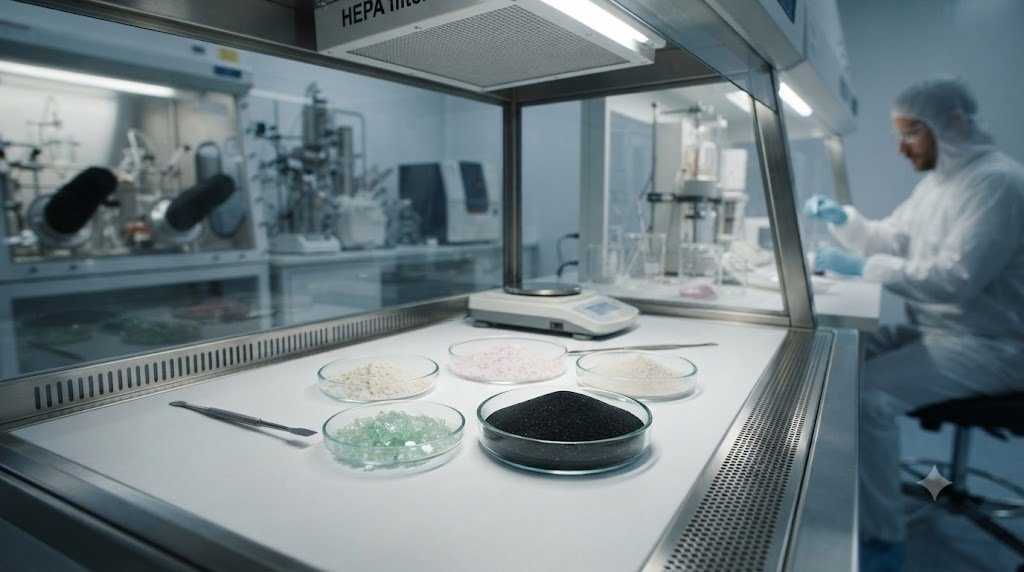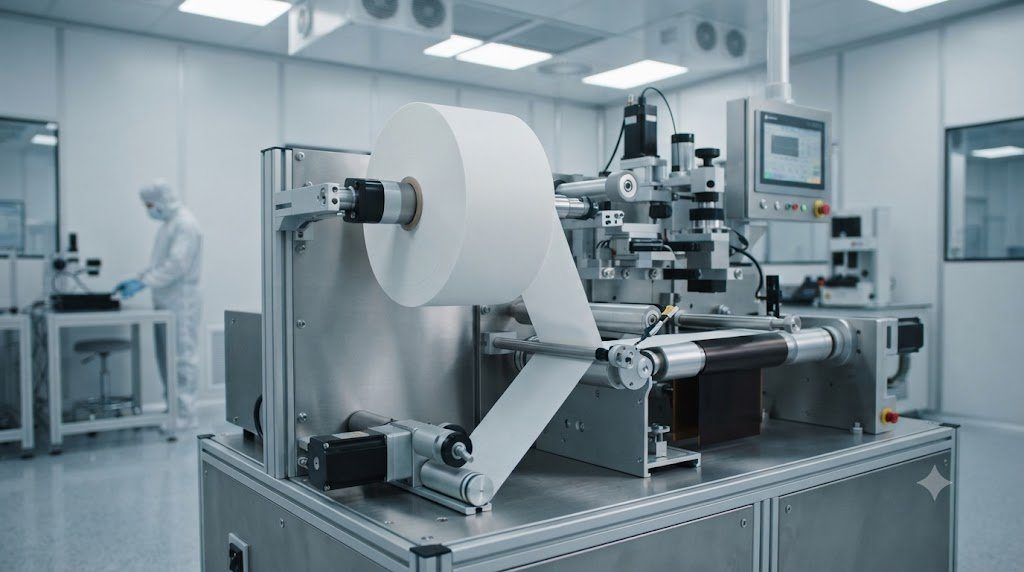
The battery separator is an ultra-thin, microporous polymeric membrane placed between the positive cathode and negative anode. While the separator is completely electrochemically inactive and generates zero electrical energy, it serves as the ultimate arbiter of battery safety, power capability, and cycle life. It must maintain absolute physical separation to prevent catastrophic dead short circuits while providing low-resistance microscopic pathways for rapid lithium ion transport. From dry-process polypropylene to ceramic-coated trilayer membranes, electrospun polyimide nonwovens, and automated thermal shutdown kinetics, separator engineering represents a triumph of precision polymer physics.
The Dual Role of the Separator
A separator must satisfy two opposing physical mandates: it must be an absolute electrical insulator (infinite electronic resistance to block electrons) while simultaneously acting as an open ionic conduit (near-zero ionic resistance for lithium ion migration) that mechanically resists piercing from metallic dendrites and thermal shrinking up to 200°C.
1. Polymer Chemistry and Manufacturing: Dry Process vs. Wet Process
Commercial lithium-ion separators are fabricated predominantly from semi-crystalline polyolefin polymers: Polyethylene (PE) and Polypropylene (PP). These polymers are manufactured into porous films through two competing industrial processes:
The Dry Process (Celgard Uniaxial / Biaxial Stretching)
Pioneered by Celgard, the dry process relies on melt extrusion followed by annealing and physical mechanical stretching without using any chemical solvents:
- Polyolefin resin is extruded under high shear into a non-porous precursor film with highly ordered crystalline lamellae.
- Cold stretching initiates micro-void nucleation between lamellae, followed by hot stretching that expands these voids into open, slit-like pore channels.
- Morphology: Dry-process separators feature anisotropic, slit-like pore structures with high tensile strength in the machine direction (MD). They are cost-effective, environmentally friendly (zero solvent emissions), and universally utilized in high-power cylindrical cells and large energy storage packs.
The Wet Process (Thermally Induced Phase Separation – TIPS)
Manufactured by Asahi Kasei, SK Innovation, and Toray, the wet process utilizes liquid hydrocarbon plasticizers (mineral oil or liquid paraffin):
- Ultra-high molecular weight polyethylene (UHMWPE) is dissolved in mineral oil at elevated temperatures to form a homogenous melt.
- The mixture is extruded and biaxially stretched simultaneously in both machine (MD) and transverse (TD) directions, aligning polymer chains isotropically.
- The plasticizer oil is extracted and washed away using volatile organic solvents (such as dichloromethane), leaving an intricate, sponge-like network of tortuous round pores.
- Morphology: Wet-process membranes are ultra-thin (down to 5 to 9 microns) with uniform round pores, superior puncture resistance, and isotropic mechanical stability, making them the gold standard for high-energy EV pouch and prismatic cells.
| Separator Property | Dry-Process Polyolefin (Celgard) | Wet-Process Polyolefin (UHMWPE) | Ceramic-Coated Separator (CCS) |
|---|---|---|---|
| Manufacturing Method | Melt extrusion + mechanical stretching | TIPS phase separation + solvent extraction | Wet/dry base + sub-micron ceramic slurry coating |
| Typical Thickness | 16 – 25 microns | 7 – 12 microns | 9 – 16 microns (Base + 2-4µm ceramic) |
| Pore Morphology | Slit-like, anisotropic micro-channels | Round, tortuous, isotropic 3D sponge | Spongy base with porous mineral topcoat |
| Porosity (%) | 35% – 45% | 40% – 55% | 45% – 55% |
| MacMullin Number (Nm) | 6 – 10 (Moderate impedance) | 4 – 7 (Lower impedance) | 5 – 8 |
| Thermal Shrinkage (130°C) | High (10% to 30% contraction) | Moderate (5% to 15% contraction) | Near Zero (< 2% shrinkage up to 180°C) |
| Puncture Resistance | Moderate (~300 – 400 gf) | High (~400 – 600 gf) | Exceptional (> 600 – 800 gf) |
2. Transport Physics: Porosity, Tortuosity, Gurley Number, and MacMullin Number
To evaluate how effectively a separator allows lithium ions to navigate its pore matrix, electrochemical engineers rely on precise physical transport metrics:
- Porosity: The ratio of void pore volume to total membrane volume, typically engineered between 40% and 55%. If porosity is too low, internal resistance spikes; if too high, mechanical strength and puncture resistance collapse.
- Tortuosity: The ratio of actual curved path length that an ion travels through convoluted pores compared to the straight geometric thickness of the membrane. Tortuosity typically ranges from 1.5 to 2.5.
- Gurley Number (Air Permeability): The time in seconds required for 100 cubic centimeters of air to pass through one square inch of membrane under a constant pressure of 4.88 inches of water. A low Gurley number (100 to 200 seconds) indicates open, interconnected pores and low ionic impedance.
- MacMullin Number: The ratio of the electrical resistivity of a separator soaked in liquid electrolyte to the resistivity of the bulk electrolyte alone. An ideal separator achieves an MacMullin value between 4 and 6, minimizing internal ohmic heating during fast charging.
3. Thermal Safety Mechanisms: Thermal Shutdown vs. High-Temperature Meltdown
The separator functions as an automated internal safety fuse that disconnects electrical current when a cell overheats:
The Thermal Shutdown Mechanism
Polyethylene (PE) possesses a melting point of approximately 130°C to 135°C. When internal cell temperatures reach this critical window (due to external short circuit or continuous overcharge), the PE polymer melts into an amorphous, non-porous liquid film that collapses the pores under surface tension. By sealing its pores shut, the separator completely halts lithium ion transport, cutting off current flow and terminating the electrochemical reaction before catastrophic thermal runaway can ignite.
The Meltdown Hazard and Trilayer Laminates (PP/PE/PP)
However, if temperatures continue rising beyond the shutdown point, the entire polymer membrane will eventually undergo meltdown—losing dimensional integrity, shrinking violently, and tearing open. Polyethylene melts completely at 135°C, which would leave the bare anode and cathode in direct physical contact, sparking instantaneous explosive short circuits.
To resolve this, engineers invented Trilayer Polypropylene/Polyethylene/Polypropylene (PP/PE/PP) separators (such as Celgard 2325):
- The inner PE core melts at 130°C, providing the vital thermal shutdown function.
- The outer PP layers have a higher melting point of 165°C to 170°C, remaining mechanically rigid and physically separating the electrodes for an extra 35°C buffer, allowing the battery cooling system time to dissipate heat.
4. Ceramic-Coated Separators (CCS): Alumina and Boehmite Coatings
In modern high-energy-density automotive battery cells, standard polymer membranes are insufficient. Automotive standards mandate Ceramic-Coated Separators (CCS):
A sub-micron slurry of high-purity ceramic nanoparticles—predominantly Alumina (Al2O3) or Boehmite (gamma-AlOOH) mixed with water-soluble PVDF-HFP or polyacrylate binders—is coated in a 1-to-3-micron layer onto one or both sides of the base polyolefin film:
- Zero Thermal Shrinkage at 180°C: The ceramic nanoparticle scaffold is thermally stable beyond 1,000°C. Even if the underlying polymer substrate completely melts, the porous ceramic skeleton retains its structural shape, preventing physical contact between anode and cathode and eliminating thermal short circuits up to 200°C.
- Exceptional Dendrite Puncture Resistance: The hard ceramic mineral layer multiplies puncture resistance, mechanically preventing needle-like lithium dendrites from piercing the membrane.
- Superior Electrolyte Wettability: Inorganic oxides are hydrophilic and exhibit high surface energies, rapidly sucking up polar carbonate electrolytes and reducing battery electrolyte vacuum-filling times by over 50%.
5. Polyimide (PI) and Nonwoven Heat-Resistant Separators
For extreme aerospace, military, and fast-charging applications, next-generation separators abandon polyolefins entirely in favor of electrospun Polyimide (PI) nonwoven nanofiber mats:
Polyimides exhibit astronomical thermal decomposition temperatures exceeding 500°C with zero melting point. Electrospun PI nanofiber webs achieve porosities exceeding 70% to 80% with interconnected 3D pore architectures, slashing internal ionic resistance and enabling sustained 10C fast-charging without thermal degradation.
6. Electrostatic and Dipole Surface Functionalization
Beyond mere mechanical isolation, modern separators act as active electrochemical filters through surface molecular functionalization. Pristine polyolefins have zero surface charge and poor dielectric interaction with dissolved lithium salts. Chemical engineers modify separator surfaces using plasma grafting, atomic layer deposition, or polymer brush coatings:
- Lithium-Ion Transference Number Enhancement: In standard liquid electrolytes, the lithium-ion transference number (t+) is only 0.35 to 0.40, meaning over 60% of current is carried by sluggish hexafluorophosphate anions. By grafting negatively charged sulfonate (-SO3-) or carboxylate (-COO-) moieties onto the separator pores, mobile anions are electrostatically repelled while lithium cations pass unhindered. This elevates t+ above 0.70, suppressing concentration polarization gradients during rapid vehicle acceleration.
- Transition Metal Cation Scavenging: When high-nickel NMC cathodes degrade at high operating temperatures, manganese, cobalt, and nickel cations dissolve into the electrolyte and migrate across the separator to poison the anode SEI. Functionalizing separator coatings with chelating crown ethers or metal-organic framework (MOF) nanoparticles allows the separator to selectively capture and trap dissolved metal ions in transit, preserving anode longevity.
7. Separator Mechanical Tension and Winding Slitting Tolerances
In gigafactory production lines, separators undergo intense physical mechanical handling during high-speed rotary slitting and automated roll-to-roll electrode winding (jelly-roll formation) or z-folding stacking:
- Static Electricity Dissipation: Because polyolefin membranes are exceptional electrical insulators, high-speed unrolling generates massive static charges exceeding 20,000 volts. If unmitigated, electrostatic discharges can puncture microscopic pinholes through thin 7-micron films or attract airborne conductive dust particles. Industrial winding machines utilize ionizing air bars and conductive carbon grounding brushes to continuously neutralize electrostatic buildup.
- Tensile Modulus and Web Tension Control: The separator web must withstand continuous dynamic pulling tensions of 10 to 30 N without undergoing necking, stretching, or plastic deformation. Any localized longitudinal stretching narrows pore diameters, inducing severe current density hotspots during cell operation. Precise servo-driven load-cell dancers maintain web tension within plus/minus 0.5% tolerances.
- Ultrasonic and Laser Slitting Quality: Rough slitting blades leave jagged burrs, micro-tears, or curled edges on the separator foil. Slitting machines employ precision ultrasonic knives or femtosecond laser cutters that melt and seal the membrane edge simultaneously, delivering pristine edge profiles that prevent internal short circuits along the electrode margins.
8. Solid-State Electrolyte Separators: Ceramic LLZO and Sulfide Glass
In all-solid-state lithium batteries (ASSBs), the flammable liquid electrolyte and porous plastic separator are replaced by a single, monolithic solid-state electrolyte (SSE) separator:
- Oxide Garnet Ceramics (LLZO – Li7La3Zr2O12): Cubic garnet-type ceramics exhibit exceptional electrochemical stability against metallic lithium anodes (down to 0.0V) and thermal stability exceeding 1,200°C. With shear moduli exceeding 60 GPa, dense garnet membranes are theoretically stiff enough to mechanically suppress lithium dendrite penetration according to the Monroe-Newman criterion. However, high grain boundary resistance and brittle fracture tendencies mandate precise high-temperature tape casting and sintering.
- Sulfide-Based Solid Electrolytes (LPSCl – Argyrodite): Sulfide glasses deliver breathtaking lithium-ion conductivities exceeding 10 mS/cm at 25°C—rivaling liquid electrolytes. Unlike rigid oxides, sulfides are soft and ductile, allowing dense, pinhole-free separator pellets to be cold-pressed at room temperature. However, sulfides react violently with ambient moisture to release toxic hydrogen sulfide (H2S) gas, requiring hermetic dry-room processing.
9. Puncture Resistance Testing and In-Line Defect Metrology
To guarantee that no separator failure occurs over a 15-year automotive battery warranty, separator manufacturers execute exhaustive mechanical and optical quality validation:
- Needle Puncture Resistance (ASTM F1306): A polished spherical needle (1.0 mm radius) presses into the clamped membrane at a constant velocity of 2.0 mm/s. Automotive-grade ceramic-coated separators must exceed 500 to 800 gram-force (gf) of resistance before mechanical rupture to ensure active cathode particles cannot penetrate the film under pack compression.
- High-Voltage Spark and Pinhole Detection: Continuous roll-to-roll testing subjects the moving membrane web to a non-destructive high-voltage electric field (typically 1,000 to 3,000 volts DC). Any through-thickness pinhole, foreign metallic particle, or localized ultra-thin defect ionizes the air gap, triggering a micro-spark that is instantly logged with GPS-like web coordinates for automatic cutting and ejection.
10. Frequently Asked Questions Regarding Battery Separators
What is the primary function of a battery separator?
The separator physically separates the positive and negative electrodes to prevent electrical short circuits while allowing lithium ions to freely pass through its pores.
What is the difference between dry-process and wet-process separators?
Dry process uses mechanical stretching to create slit-like pores without solvents; wet process uses liquid plasticizers and extraction to produce ultra-thin, round, isotropic pores.
What is the ‘thermal shutdown’ mechanism of a separator?
At around 130°C, the polyethylene in the separator melts and collapses its pores shut, blocking lithium ion flow and shutting down the cell before a fire can ignite.
Why are trilayer (PP/PE/PP) separators used?
The middle PE layer melts at 130°C to stop current, while the outer PP layers remain solid up to 165°C, keeping the electrodes mechanically separated.
What is a Ceramic-Coated Separator (CCS)?
It is a polymer separator coated with a thin layer of alumina or boehmite ceramic nanoparticles, preventing thermal shrinkage up to 180°C and blocking dendrite punctures.
What is the Gurley number in separator specifications?
The Gurley number measures air permeability: the time in seconds for 100cc of air to pass through the membrane. Lower Gurley numbers indicate faster ion transport.
How thin are modern electric vehicle separators?
Modern EV separators range from 7 to 12 microns for the base polymer film, plus 1 to 3 microns for ceramic coatings.
What is the MacMullin number?
It is the ratio of the resistivity of the electrolyte-soaked separator to the bulk electrolyte alone; ideal values range between 4 and 6.
Can a separator prevent metallic lithium dendrite shorts?
Ceramic-coated and high-tensile wet-process separators provide strong mechanical puncture resistance that suppresses dendrites, but severe overcharging can still bypass thin films.
Why is high electrolyte wettability critical for separators?
Fast, uniform electrolyte wetting ensures complete ionic conductivity across the entire electrode surface, preventing localized high-current hot spots during charging.
What is the Monroe-Newman criterion in solid separators?
It states that a solid separator must possess a shear modulus at least twice that of metallic lithium (~6.8 GPa) to mechanically suppress dendritic lithium growth.
How does static electricity impact separator manufacturing?
High speeds create electrostatic charges up to 20,000V that can puncture pinholes or attract airborne dust, requiring continuous active de-ionization bars.